December 25, 1833
Christmas. In the morning, bright sky. Strong, cold wind from west hora 5 south. At seven thirty, 20°F [−6.7°C]. Several Indians came early; among them were Medicine Bird and Péhriska-Rúhpa. Mató-Tópe was still here when Two Ravens came, with whom he does not get along well. He left immediately without looking at him.
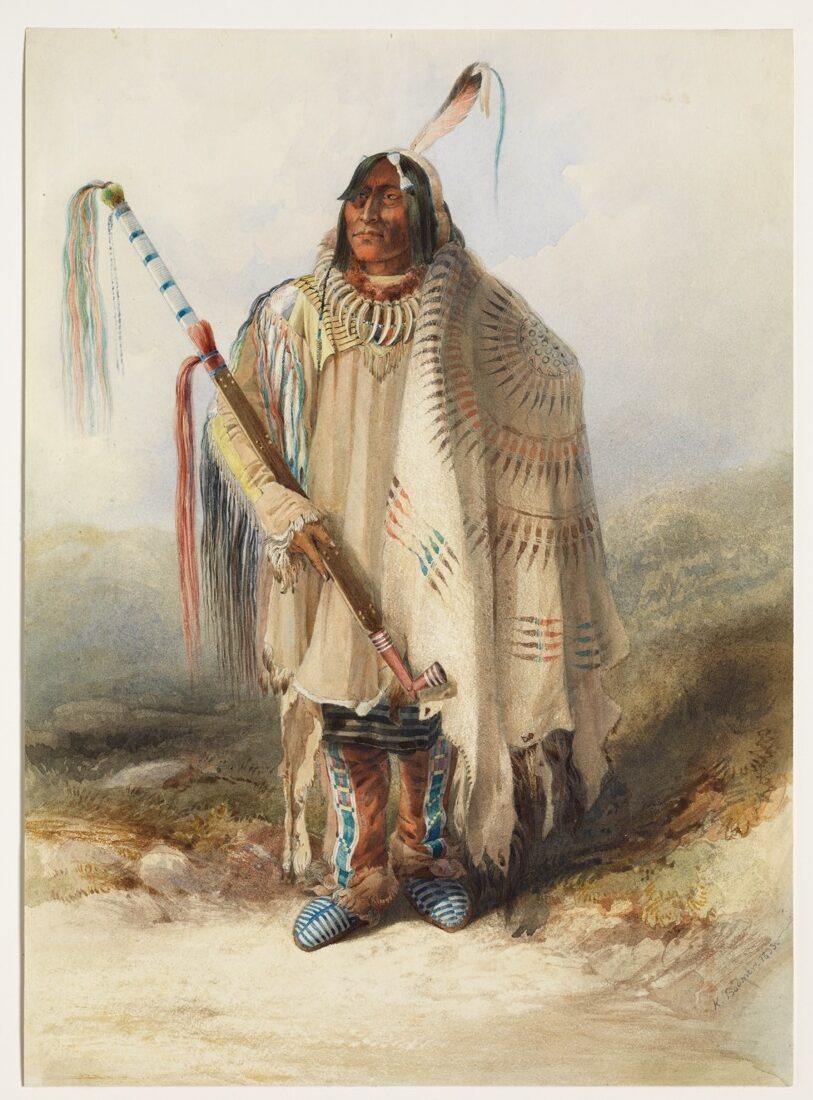
Later, Kähka-Chamahän (‘ch’ velar), Little Raven, the chief from Ruhptare, visited us—a sarcastic, shrewd man. They expected to get whiskey today, but there was none in the fort. Also, the deaf-mute had come, and Durand with his Dacota wife and child. The room was full most [of] the time. Péhriska-Rúhpa (they actually say Pähriska-Núupa) said he intended to leave me his bow, quiver, and [clothing] as soon as his picture was ready. However, he did not include his robe, which was especially beautiful, with a threefold, colossal sun or, actually, a crown of feathers [painted] on it. In the adjoining room, the engagés made noise in French-Canadian jargon. They got slightly better food today. For some time they had had no meat, just corn cooked in water, without even any fat. At twelve o’clock, when the sun shone brightly, 21 1/2°F [−5.8°C]. Wind like this morning.
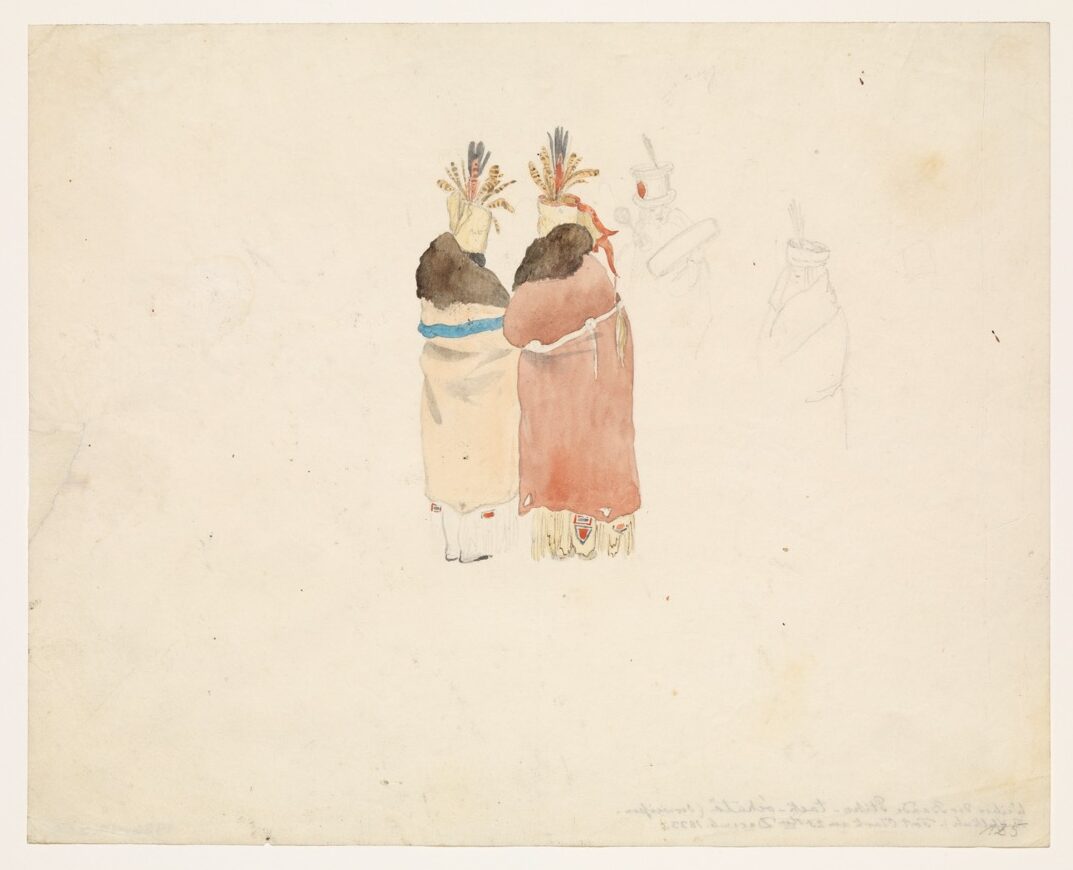
 When we were ready to sit down at the table, there was a loud noise. The women’s society of White Buffalo Cow (Ptihn-Tåck-Óchatä) moved into the fort and performed their dance in the courtyard. The band consisted of seventeen women, mostly elderly, and two men. One man was the drummer and the other had the chichikué; the latter carried his gun in his hand. An old woman walked at the head, wrapped in the hide of a white buffalo cow. In her right arm she carried a large bundle of brushwood, like a horn of plenty, to which were fastened down feathers on the tips and, at the bottom, eagle wings and a metal container. Another woman had the same kind of bundle in her arms. On their heads, these women all wore a cap made from a high, wide piece of white buffalo skin joined in the back. This [headdress] had a tuft of eagle owl and raven feathers in front. Only two of them wore skunk skins on their heads. The men wore nothing on their heads. All the women were painted alike: their left cheek and eye [were] vermilion; beside the right eye on the temple, two sky-blue spots. All except the first woman wore colorfully painted women’s robes, [although] two wore brown buffalo robes with the hair on the outside. They arranged themselves in a circle. The music began quickly with a fast rhythm. The men sang first, [then] the women began to dance and sing in a loud, high-pitched voice, as if stepping on the tails of cats. They danced, waddling like ducks, staying in the same place, stepping from one foot to the other, lifting one foot higher. After a while there was a pause; then the dance began anew. Most of these women were homely, several very tall, [although] one young one was extremely small. Only a few very old women had the black, tattooed stripes on their chins.
These women had hardly left when three engagés arrived from Fort Union, bringing the mail from there. I received letters from Fort Mr. McKenzie and Mr. Hamilton, indicating to me that a new fort, called Fort Jackson, was being built at the mouth of the rivière aux Trembles. Mr. Chardon was to oversee it. The climate at Fort Union had been very mild up to the fifteenth [of December], when the people left there. The river was totally without ice, and no snow had fallen yet. I was invited to pay a visit to Fort Union. But in this extreme winter weather, my health is too [important to risk]. The men had been traveling eight days. We were promised that the desired provisions (coffee, sugar, rice, tobacco for sakkakomi, and other things) would come shortly, by sled at the next opportunity. This evening I found out from Mr. Kipp that Mr. McKenzie had directed him to come to Fort Union. The wind had blown down all the newly erected pickets there.
On the Yellowstone, the Indians, probably Gros Ventres des Prairies, had shot a white man. The news arrived via the Indians that Doucette had been shot by the Blackfoot after he had returned safely from his trip to the Kootenais. In the evening de l’Orme told us that Governor Semple was dead at Red River, killed by a band of half-breeds that included Deschamps. The story is very interesting [and] incriminates those people terribly, most of whom deserve the gallows.