July 23, 1833
Early in the morning, nice and clear; later, slightly overcast sky, pleasant. The hunters left early, Dreidoppel with them. Soon we found an ordinary and a black-tailed deer hanging on trees on shore. While fishing, an engagé caught a Petromyzon (see the picture and description) with an unattractive gray-brownish color. I do not know whether this is the species that occurs in the Mississippi; there are, in any case, larger ones there. At 7:30, 67°F [19.4°C].
At [a] bend of the river, one now approached the hill chain on the left bank. Here it has a singular shape: rather flat on top, gray-brownish, and bare; on top, in the ravines between the eminences [are] small, blackish cedar bushes that formblack form black patches. Before the hills, on the steep, 10to 15-foot-high clay bank, [is] a prairie overgrown with bluish green Artemisia thickets. On the preceding days we had passed several creeks, all of which were without water and hence need not be considered here. Lewis and Clark’s map lists a large number of dry rivers, not all of which I am recording here. Dreidoppel returned. He had shot the doe (Cervus virginianus) [mentioned above]; Papin, the black-tailed deer. They had seen buffalo and many elk and had also wounded one of the latter. Dreidoppel found Unio [— —] at an often-flooded spot. [This is] the first mussel we have seen on the Missouri. In the Musselshell River farther upstream, we will probably find several of them.
I wanted to have the hide from a bear’s forepaw tanned by our Blackfoot woman, something the Indians can do very well, but she declined because she cannot work on anything from a bear. The Indians are exceedingly superstitious; each one has an animal that is medicine, or sacred, to him. They dream and have their dreams interpreted by their shamans; this is when they usually find the opportunity to choose some such object. Often their magic or protective device consists of a little pepper, mustard, ginger, or even a coffee bean, which they then carry well wrapped on their person.
Below the forest trees along [the] shore, in short thickets of roses as well as in the prairie, that is, in bushes at certain spots, the large, above-mentioned aromatic Asclepias occurs. We navigated somewhat farther and then, on the prairie to the right, on the bank, found several buffalo killed by Papin; we loaded the meat. On this plain with low shrubs and plants, many mosquitoes were active; the weather was hot and calm. We approached the hill chain of the left bank; the river turned to the right. A section of the hills was completely bare and grayish brown, dark; several were cut off steeply toward the river. As we came nearer, they were partially hidden from us by woods on the bank. Farther on, a beautiful view before us: the unique chains of mountains or hills are gray with small black patches of cedar; through their shadows, the sun reveals the ridges and small ravines on them very nicely.
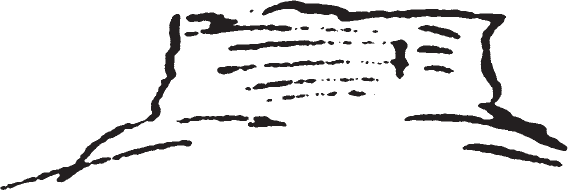 Mr. Mitchell went hunting with Bodmer. At 11:30 we reached a now nearly dry creek, which came twisting before the hills from steep, high clay banks. On [the] left bank lay several very strange, isolated clay hills; higher hills followed. When one climbs up them, one often sinks over one’s ankles into the dry, crumbly clay mass. These hills are completely bare and mostly devoid of vegetation. We saw our hunters climbing over their heights. The men on the cordelle killed a rattlesnake (Crotalus tergeminus). The prairie on which they were walking had a high, steep clay bank. It was twelve o’clock, and they were relieved; it was curious to see how they slid down in the dust and [how] the others [who relieved them] helped each other climb up. At twelve o’clock, 72°F [22.2°C]. In all the steep banks of the clay deposits of the Missouri, one can see the reddish brown remnants of decayed timber, sometimes in a vertical [or] partly horizontal position. At the mouth of the second Dry Brook mentioned by Lewis and Clark, we found our hunters, who had not shot anything but had tracked an exceptionally large bear, whose tracks measured 7 3/4 inches in width.
We continued on and soon saw the bare, gray-brown hills behind us; those to our left had black patches of conifers in their ravines. We crossed to the right bank, where Saucier, who asserted that he had shot three buffalo, was waiting for us before the forest. He certainly had shot one, since he had the tongue with him. When he reported that a herd of these animals was not far away, Mr. Mitchell, Bodmer, Deschamps, and Papin went ashore [while] we moved on in the oppressive heat.
On the high bank of the prairie stood a large old, hollow cottonwood in which a pair of magpies had built their nest. One saw twigs from it [projecting] out from the hollow area, and the already grown young birds were perched on them. For a long time, generally since we left Fort Union, the Missouri no longer had islands; now we had one before us, which Lewis and Clark also indicated on their map. We soon reached it and passed it on our left. In front it had a bare sandy point and then several gradations of willows with cottonwoods in the middle. On the right bank of the mainland, the prairie was situated on a 12-foot-high, steep clay bank. The left bank of the mainland is covered in front with willow and cottonwood forest, behind which rose the extremely strange, ash-gray clay hills with blackish green patches of evergreens. We saw our hunters moving far ahead of us on the prairie; they had been following the edge of the bank. Before us, where the river turned left, was a remarkable, completely naked, high, uniformly colored, dark-gray clay mountain, which projects in front like a foothill at an angle. In the middle there is a tall crown on which one of our hunters appeared, [using the height] as a point de vue [viewpoint]; as we learned later, [it was] Deschamps.
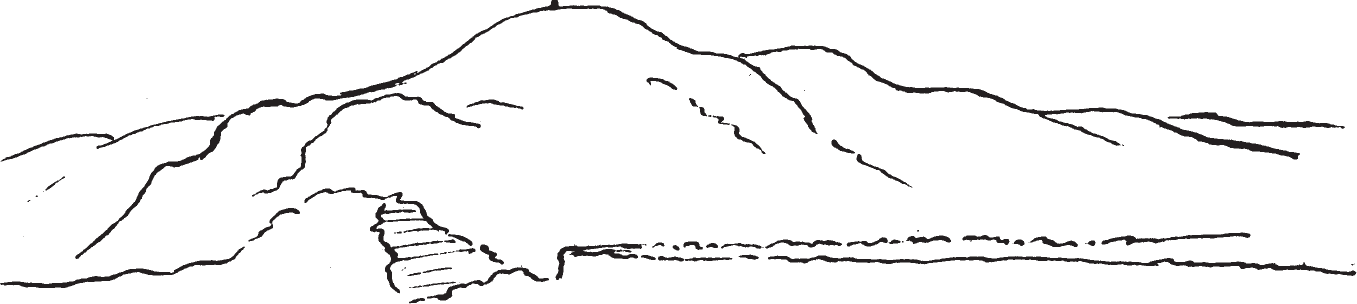
A light wind now arose. It was 2:45. Before we reached these elevations, our hunters came aboard again; they had seen nothing but two buffalo. In this area the island came to an end with a sandbar. On the prairie and on its clay bank, there now grows among the Artemisia a shrub [— —] with gleaming green foliage and aromatic wood that we had not observed previously. Before the hills we took the men from the cordelle aboard and poled the ship to the other side, because the river was shallow. We now had the bare clay elevations close to the right; here and there in their small furrows grew green plants in narrow rows, [like] thin, green stripes.
We were nearly opposite the tip of the island when the channel became so shallow that we ran aground. The men all went into the water and pushed in every possible way. The river was examined in all directions, but to no avail. In the end the boat could only be moved backward, which was then done. We turned around and went back to where the island began, whereby we certainly lost 6 miles. We navigated around the tip of the island, hoisted the sail, and sailed swiftly against the current. On the left bank there was a tall old cottonwood forest, which concealed the hills behind them from us. On the right bank, a creek emptied. We sailed rapidly onward and found prairie on the left bank with old trees scattered along [the] shore; woods and willow thickets to the right. Behind On the prairie, extremely odd clay hills, with strange, nipple-shaped foothills, arose, and farther on, tall fortresslike walls with clumps of dark cedar or coniferous bushes. Before us the river made a big bend around wide sandbars along the left bank; in the distance, very unusual mountains from which the river descends.
Before the bend of the river, we halted for the night along an extensive prairie; it was completely overgrown with bluish green Artemisia and the thorny shrubs of the plant with cylindrical, pulpy, almost linear leaves. Our hunters had come in shortly before and had brought a doe. The evening was windy, the sky overcast. At dusk Mr. Bodmer made one more excursion onto the prairie. He saw a dark object running, which he took for an Indian on horseback moving through the hills, but he could no longer see clearly. Bufo clamosus was found nearby. Mosquitoes were very annoying.