July 25, 1833
Early in the morning, beautiful, clear, warm weather. We went out early [and] crossed over to the right in the dinghy to a narrow wooded promontory, behind which a vast prairie extended, exactly like the one described yesterday. Here there were very many blackbirds, Muscicapa, woodpeckers, and Fringilla grammaca in large numbers. By chance we found a large covey of the mountain or prairie cock (Tetrao urophasianus)—magnificent, big birds. Unfortunately, we had loaded with ball and did not get any. Dispersed, they soon alighted again, and with a bird dog we could easily have shot them. We did not find any game on the first wooded promontory; I saw only a young rabbit and shot a great horned owl (Strix virginiana) from an old cottonwood, around which flocks of Muscicapa and blackbirds raised a cry.
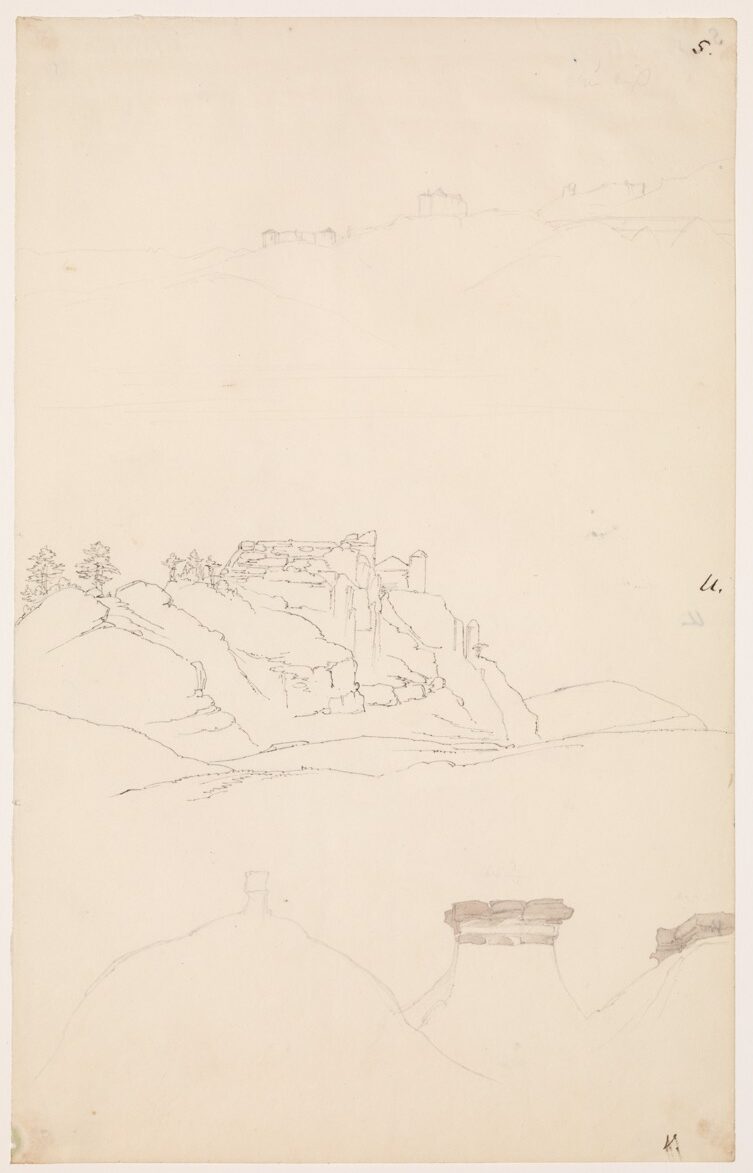
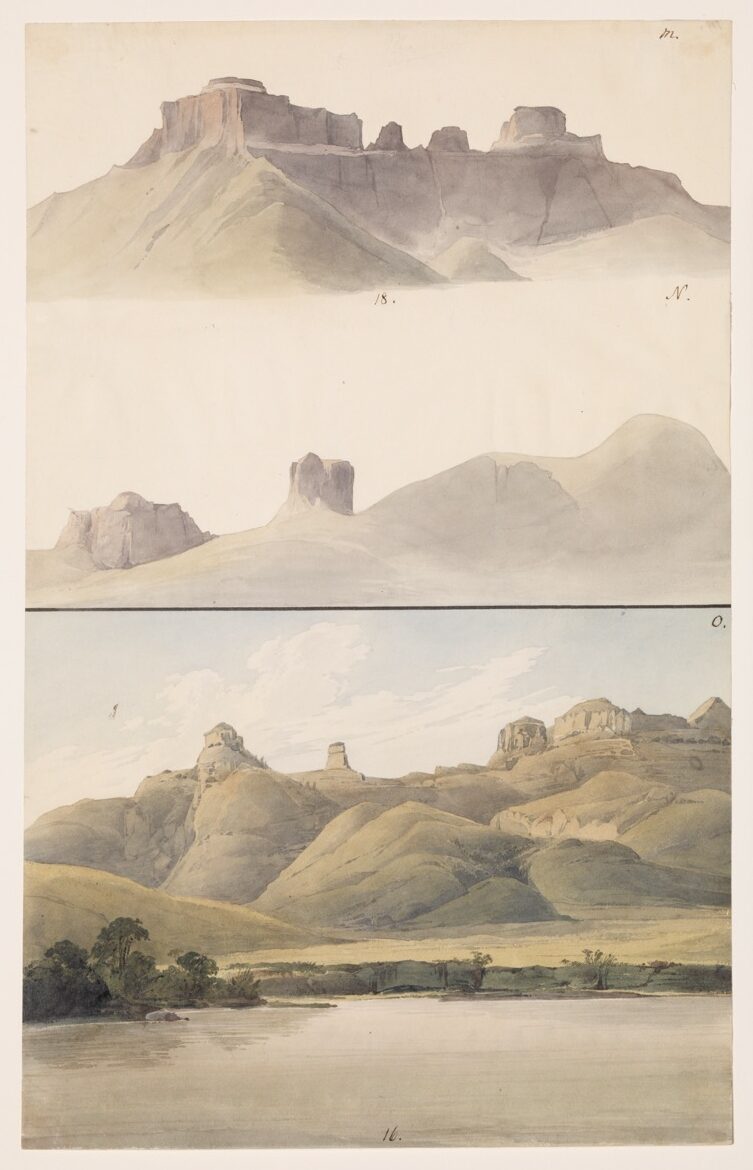
Papin and Deschamps went farther; we waited at the end of the forest for the keelboat, which came over and took us on board. On the left bank, the chains of the strange clay hills stood close to shore; they had incredible domes, including some just like mountain castles on the Rhine (see sketches M. and N.). Individual firs are scattered over the hills. The wooded promontories were already becoming smaller and smaller; soon the unusual clay mountains would also come to an end; boulders took their place, and then the forest ceased entirely. Farther upstream one would reach the high mountains, which the French call les Mauvaises Terres [Badlands] and where the bighorn (Ovis ammon) is frequent. On shore we saw a magpie nest on an old cottonwood; these birds were plentiful today along the edge of the prairie. [Their] nest was built in the same manner as in Germany. The right bank, as well as all those along the prairies for the past several days, consisted of steep gray clay, 15 to 20 feet high, often rent by clefts [and] split into slender columns; often one sees holes and even caves inside them. This morning we saw one with a fine arch, which was visible to a depth of at least 30 paces and certainly went even deeper.
At the next bend of the river to the right, there were again very unusual mountain domes on the left bank above the high hills (Mr. Bodmer’s sketch O.). In front of them along [the] shore, there was rough prairie with bushes (which are always joined [together here]) and individual old cottonwoods on the bank. On the other side, along the right bank, [was] a border of shady cottonwood trees and branchy young underbrush. Somewhat farther [along], though still before the bend of the river, the hunters returned; they had shot two bucks and a fawn of the black-tailed deer species (Cervus macrotis Say). From the fawn I took the regrettably [only] partially remaining skin. While we paused for a short while to load dry wood, two buffalo were sighted ahead of us in the prairie; the hunters crept close and shot both of them. Our men took a great quantity of meat from them, because in the future we may not see so much game.
We continued [our journey], and soon there was a creek to our right. At twelve o’clock, 88 1/2°F [ 31.4°C] in the cabin. After several hundred paces, we came upon a larger creek with steep banks but almost completely without water; [it was] just a bog, and the men with the cordelle threw tree trunks and branches over it, on which they made their way across. In this area there was an island with cottonwoods in the river.
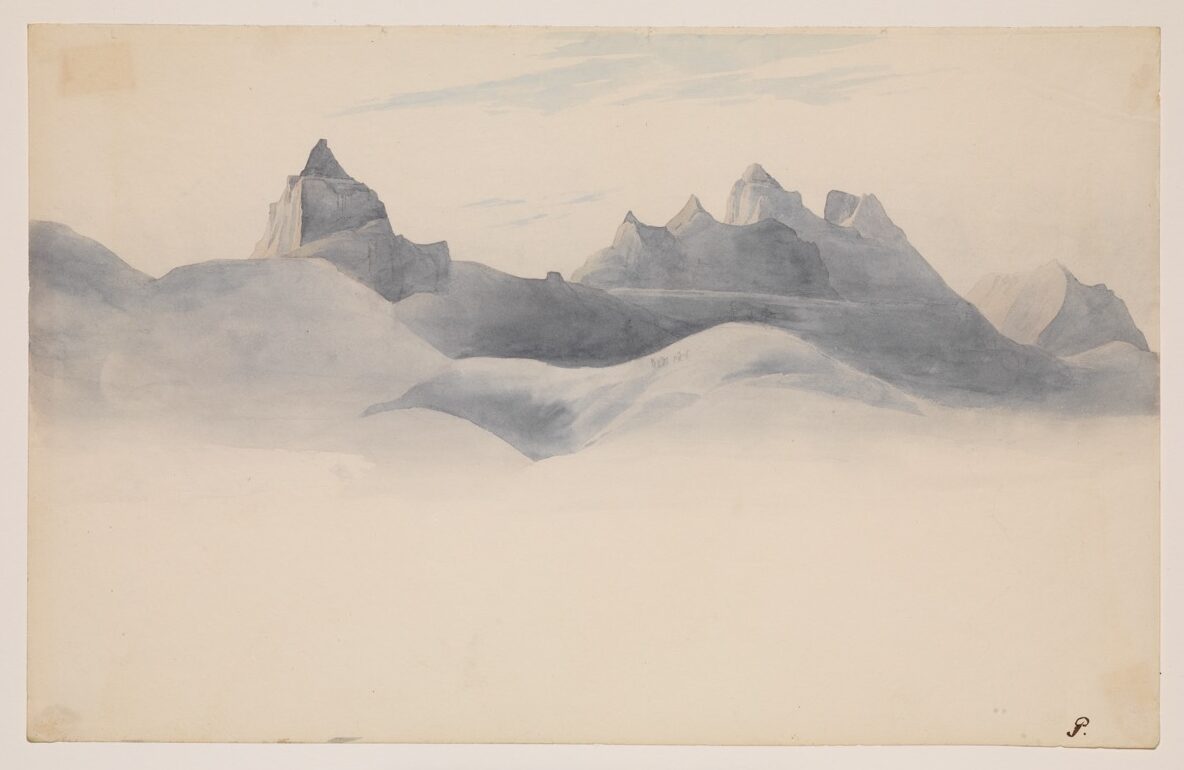
At noon the wind became strong; the crew had to be taken aboard to push [with poles]. We saw several Indian lodges built of wood under old cottonwoods on the bank. At the edge of the river, [one] frequently [saw] old cottonwood trunks [and] occasionally woods. The mountains all around are becoming higher and higher; they have extremely strange domes like pulpits, little towers, pastries, and the like set on their ridges, which are often notched like combs saws. Several very unusual ones appeared, especially on the right bank (that is, the one that remained to our right) (see Bodmer’s sketch P.). Navigation is much easier here than farther downstream, for there are no more swampy sandbanks into which the men sank and [so] constantly delayed us. Here, too, the river water is not as dirty as it was before. Its banks are mostly 10, 15, and more feet high and steep, yet the men on the cordelle for the most part had a path down below at the river on which they could walk.
We sailed with a brisk wind. The mountains before, behind, and beside us were now so altogether peculiar that we conversed about nothing else. Nowhere else had I seen such high, sharp ledges, jagged on top with vertical ledges descending along the side, their mostly bare, gray masses without any vegetation, except for occasional spots of scattered, rather short [conifers]; surely it is very necessary that qualified geologists describe and investigate these mountain chains. The domes, towers, columns, and, I would even say, individual massifs and the like stood out in a most strange way against the blue sky. The sun caused the most dazzling shadows on them. Unfortunately, we could not stay; inexorable destiny permitted us only to hasten through here.
We talked with Deschamps about the Indians’ sources of food. He told us [that] the Assiniboines, Crees, Ojibwes, and some northern Indians very often suffered from hunger, and that whole families die because of this sad misfortune. Therefore, they eat every living thing they can find, except for snakes. They have only a few dogs, because they usually kill and eat them in an emergency. Since they have few serviceable horses, they cannot shoot enough buffalo; therefore, they have to resort to a kind of drive. A hunting party divides and moves in two groups; in this manner they also pitch their [tipis]. The herd is driven in and hemmed in from all sides and met up front, especially by the men. The so-called [buffalo] park is even more complete. The [other] Indians of the Missouri do not suffer so much from hunger, [for] they have more horses and more game in their territory.
Because the wind blew only in gusts and was not very favorable, either, the men were put on the cordelle again. But then the wind became stronger and we sailed on. To the right and left along [the] shore, the prairies were covered with the bluish shrubs of Artemisia and of the green [— —]. On the edge of the bank, old cottonwoods here and there with high, spreading crowns and thick, rough, cracked trunks of a dark ash-gray color. The peculiar high clay mountains everywhere formed the background. They became higher and higher, more gigantic, more massive, with patches of a gray-brownish, whitish gray, often spotted whitish; their upper section has horizontal layers and narrow stripes; the domes are like small short towers, pavilions, small Chinese garden houses, etc. In general they have the appearance of the limestone mountain Säntis in Appenzell, or of other Swiss mountains.
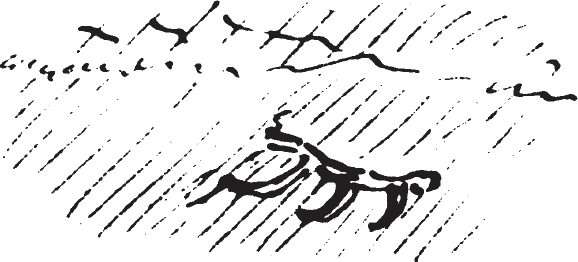 Someone shot a wild goose from the deck, and a man swam all the way across the river to fetch it. In the steep wall of the left bank, we saw a deer antler jutting out freely into the air. It was buried in the mountain rubble, and the end tines were firmly embedded. These are the high rugged mountains where the bighorn, or argali, begin to become more numerous. The higher one goes, the more one finds this beautiful, interesting species of animal.
The sail was hoisted and the men were on the cordelle at the same time. Thus one adapts alternately to the bends of the river. The men on the cordelle killed a big rattlesnake that had swallowed a large ratlike rodent, undoubtedly a Neotoma. Black storm clouds had long since arisen; as we were approaching a bend in the river, a thunderstorm broke. The boat was driven from shore, and soon the crew could hardly hold onto the rope any longer. They worked furiously, and with the poles they succeeded in moving on. Desjardins, one of our men, had severe abdominal pains and was very ill. This happens when people eat the now-very-fatty venison and then drink immoderate amounts of water in the great heat. Such cases occur frequently during keelboat journeys on the Missouri.
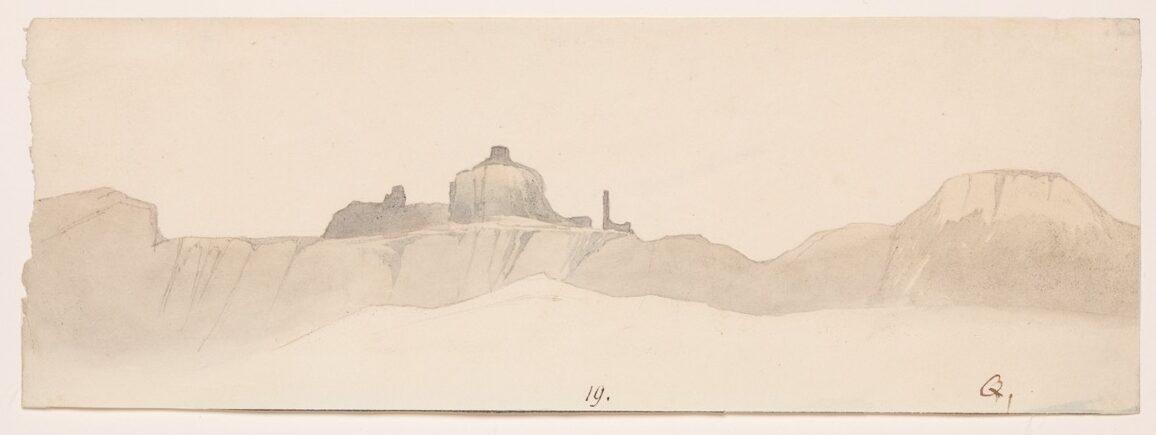
When we came around the bend, the very strong wind became favorable [and] we sailed as swiftly as an arrow. Ahead of us appeared mountain domes that fully resembled white mountain castles with brownish roofs. On the mountain there was a high, snow-white stratum; above this, remnants of an upper stratum were still standing, which created the illusion of roofs on white houses (see sketch Q.). We also saw similar ones to the right. None of us had ever seen strange mountain shapes of this sort.
We were occupied watching and observing this peculiar world of nature when the storm suddenly increased so much that it drove our boat too rapidly and tore the sail to bits. We therefore hurried to the left bank and secured the boat with several hawsers. Near us the trees bent down. More and more storms were gathering; thunder and lightning appeared in several places. It was also oppressively warm. Some of us left the boat and went to a rough sloping plain above the bank that extended, hilly and uneven, toward the mountains. Along the river a rough prairie, with the usual growth, stretched out. Yellow-brownish sandstone fragments, stratified and shaped in various ways, lay about in the foothills. All around rose the marvelous ranges of the high gray-brownish and whitish gray mountains with their jagged, conic, or even more marvelously shaped domes, variously striated and with blackish green patches of scattered evergreens which (what a sudden change!) only today have taken on this magnificent character; they now surrounded us as though we were right in the midst of the Swiss mountain ranges.
The Missouri, here rather narrow, winds convulsively between these high ridges of clay, argillite, and sandstone. The bare, petrified world of nature surrounding [the river] is enlivened on its partly fresh, green banks only through borders of tall cottonwoods or young bushes. The plants on the rough plain were mostly dry: Allium reticulatum, with its white flowers, was completely withered; the Cactus ferox were scanty and dried out. Only bison bones, whitened by the weather, greeted us; droppings from these animals and their huge tracks were everywhere. We saw two of these stately animals walking off in the distance ahead of us, [and] three of our hunters immediately set out.
Rain soon began to fall. Behind us in the north west was the most powerful thunderstorm; a second one farther in the west; in the east, too, there was lightning. They soon dispersed, however, and the atmosphere remained very warm. We had halted here for scarcely an hour when the men were again placed on the cordelle and the journey continued. We now approached the white mountain castles, as we called them; the Molzberg, located in our area [in Germany] and which belongs to Count Watterdorf, and Castle Deren, on the Lahn near Limburg, were noted as quite similar. As soon as one gets closer, the resemblance naturally vanishes, but from Mr. Bodmer’s sketches [— —] one can easily see that from a distance there is a very close resemblance.
We soon put in at the left bank, about 300 to 400 paces from the place where we were during the storm. Not far from here, in the prairie, was a prairie dog village, which we visited, but rain clouds of terrible appearance drove us back. Later we saw a white wolf coming down from the hills; it lay down in the level prairie. Dreidoppel and I crept toward [it] behind the bushes; the former approached it, startled it, and shot it with a combination over-and-under rifle and shotgun. It was a completely white she-wolf, and not large. The air was very murky and full of thunderstorms, the evening oppressively warm, and the mosquitoes on the prairie very annoying. We had grown very warm [as] we carried the wolf a long distance to the boat.