July 27, 1833
Early in the morning, nice, calm, extremely warm weather. At 3:30, with Dreidoppel, I went on the left bank across the eroded clay hills toward a large wooded area before us. A big bear ahead of us had been digging for roots. A rugged wilderness connected the forest with the hills. There was much dry timber inside it; many thorny and dry plants grew everywhere. Unfortunately, Papin was ahead of us; he had already shot a deer. We saw two bucks. Dreidoppel saw two deer in a thicket, and I saw another one but was unable to shoot. Two large great horned owls and a falcon hawk (Falco velox Wils.) were perched before me, and I shot the latter. In the shady forest there were excellent grassy ravines and green areas; unfortunately, the mosquitoes were intolerable. We tracked buffalo everywhere but [found] nothing fresh; a large bull elk (Cervus canadensis) had just come out of the thicket ahead of us. In the tall trees on the sparse, scorched and dry plains [of] the prairie, the big Muscicapa and blackbirds were very abundant, the latter in numerous flights with their young.
We saw the keelboat arriving at the upper end of the forest; but since it was navigating along the other bank, we shot more birds. The lovely little swallow with the white abdomen, green back, and violet feathers covering the upper tail, Hirundo bicolor in the systems [of classification], nests in the hollow old cottonwoods on the bank. It is one of the most beautiful swallows in America. Facing us on the riverbank lay two black-tailed deer (bucks) that Deschamps had shot. They were loaded onto the boat. We wandered still farther for an additional half hour through the glowing prairie, where the finch with the striped head (Fringilla grammaca) in large numbers was flying about with its young. Then we climbed through a ravine [down] to the river, sat down on the bank, and cooled our burning thirst with the excellent water of the Missouri. The dinghy fetched us.
We had just passed an island (Kid Island), to our left. Now, at nine o’clock, it was oppressively hot. Along the right bank where we were sailing, high walls of hard gray, crumbling earth again appeared above the forest. At the place where we boarded the dinghy, or rather a few hundred paces before it, stood four hunting huts, or those of a war party of Blackfoot Indians, whose territory we were now in (that is, [the territory] is not inhabited by them, just traversed by individual raiding parties). The boat was pushed and pulled, partly along the right bank [and] partly in the middle of the river. After an hour and a half, [the boat] approached the mountains, which rose up with rugged summits, small clusters of evergreens, numerous ravines, and small whitish conical tops. At their base [a] rough, dry prairie [was] overgrown with shrubs; [there were] broken banks and sometimes old, often dry cottonwoods along the bank. 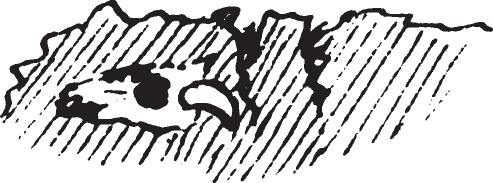 Farther on, there were again clay walls on the right bank, dry and steep, over which the men on the cordelle could barely climb. One also saw wood, bones, and sometimes whole buffalo skulls peering out from the clay. Papin was sitting on the opposite bank before the forest. He had shot a cow elk, the venison of which was fetched by the dinghy.
 On the right bank, argillite and apparently graywacke, too, appear underneath the clay. A narrow white stripe separated the former from the clay, on top of which there was a cavity that opened upward. At twelve o’clock, 85°F [29.4°C]. The sky has turned cloudy. Very sultry.
Messrs. Mitchell and Culbertson returned. They had climbed the hills to the right and had had an incomparable view. To the west (hora 5 southward) they saw the Little Rocky Mountains, like blue clouds in the distance; farther to the east (hora 7 southward), the Musselshell River. Between the mountains we had [recently] passed and the Little Rocky Mountains, they saw a broad green valley, completely covered with countless buffalo (bison). From the hills they brought nice shell impressions, some of which we also found on the bank of the Missouri at twelve o’clock. The climb to the hilltops was laborious. They had to climb three tall hills, and on the highest, where they arrived terribly heated, a strong wind was blowing. Among the mountains they surveyed was the so-called Bears Paw, which one also sees very clearly from Fort Piegan (McKenzie), about 40 miles away. On the dome of the highest hill stood a strange rock formation like a column, which supported a flat rock shaped like a table. It consisted of a brittle, crumbly material, undoubtedly argillite or sandstone.
We [continued] in the bend of the river along the right bank and then shoved with poles in the middle of the river, [until] it began to thunder and very [dark] black clouds rose in the southeast. It was about four o’clock. We saw the thunderstorm ahead of time and tied up on the left bank; the thunderstorm soon broke. Thunder, storm, and rain were heavy. The latter lasted scarcely half an hour, but the wind continued to blow hard. As a rule in this region and during this dry season, thunderstorms are accompanied only by windstorms [and] seldom by significant rain, a peculiarity of this region. Our little ship is now completely dried out from the intense heat; the joints in the deck [are] open, and hence we dread the rain, which gets us wet in our beds.
Dense willow thickets stood not far from the clay bank to which our boat had been fastened. Behind [this] rose high hills on which our crew clambered around while others on the ship below joked and played all kinds of games. During the last few days, many catfish had been caught; now, too, the lines were tossed out. Several hours later the weather looked somewhat better. Because the wind had subsided somewhat, we put twenty-nine men on the cordelle [and] had them partially undress. We went farther up the river, which here was very shallow and had many sandbars. The crew, in the middle of the river, were up to their waists in water. We went 1 or 1 1/2 miles farther and put in for the night on the left bank. The sky was dark and threatening. By nightfall the wind was blowing hard; [there was] thunder and lightning in several directions.