July 28, 1833
In the morning, gloomy sky, light rain, strong wind, cool. It had rained during the night, and [a] strong wind had been blowing. We continued navigating in the river by poling for a stretch. Along the right bank [we] encountered many snags, which we avoided. Dreidoppel and the hunters went out early to hunt. We had many willow thickets and narrow wooded areas along the river. Behind them the hills rose, gray-green with partially withered grass and plant growth and individual spruces on the tops. On the left bank are higher mountains with strange summits with flattened domes or small turrets and little towers on them. Driftwood, sometimes in large amounts, on the sand along the shore.
At 7:30, 67°F [19.4°C]. The skulls that had been prepared with great effort and other objects had been deliberately thrown into the river. I had already lost two bears’ heads, an antelope head, a white wolf, and several other things in this manner, and even though Mr. Mitchell had threatened to punish such transgressions severely, they still occurred. Therefore it was hardly possible to make any kind of collection on this keelboat. And despite all the interesting objects we acquired, my collection has, as a result, remained quite insignificant.
Since the wind was favorable, we hoisted the sail and moved rather swiftly. Because of the light rain yesterday and during the night, all the vegetation looked refreshed and the hills had a blackish tinge. Dreidoppel came in; he had shot a two-year-old doe. Papin and another man had nothing. A small creek, which Lewis and Clark mention but do not name, empties to the left.
A little [farther] upstream, we got out on the left bank, Mr. Mitchell, Culbertson, and I, to visit the Musselshell River, which empties somewhat farther upstream [and] which we thought to be not far from here. We entered a tall, beautiful cottonwood forest with a dense underwood of tall rose bushes through which we had to force our way. In this forest there was the most splendid opportunity for game. In the forest, which lay before the prairie and the hills, beautiful green spaces alternated with tall, luxuriant grass. Here we found the healthful purple Monarda; a plant with small, pretty ultramarine papilionaceous flowers set in whorl-like fashion, foliis quinatis sericeis, with stems whitish underneath, green on top ([— —]); and the pretty yellow flower with petals lopped downward ([— —]), etc. We met Papin and another man who had just missed an elk; we soon roused four elk, which we could not see because of the high rose bushes. They came toward the other hunters, who fired seven shots in all but did not kill anything. The whole forest was full of elk lairs and fresh droppings. Among the roses, gooseberry bushes with black berries (Ribes [— —]), the stem of which is densely covered with reddish brown thorns, grow plentifully. The berries here were ripe but somewhat sour.
The Musselshell River did not flow here, and because it began to rain rather heavily and we were very wet from the tall grass and the bushes, we called out to the skiff and returned to the keelboat. Then we navigated around a bend of the river to the right; to the left we had woods and willows. Behind us, the chain of high hills, and to the right, rugged earthen hills with individual small shrubs. At eleven o’clock we reached the mouth of the Musselshell River, about 70 paces wide. It emptied on the left bank somewhat to the southwest; [there were] thickets and forest on both sides of its mouth and, 600–800 paces back, high graygreen hills with valleys and with individual evergreens on the crests. For a long time this river flows rather parallel with the Missouri, for from Fort Piegan [McKenzie], one can reach it in 30 to 40 miles; and not until 5 to 6 miles from its outlet into the Missouri does it turn toward the latter. Indians do not live along its banks; they do, however, stay near its source. Its mouth is estimated to be halfway between Fort Union and Fort Piegan, which we will scarcely reach in less than seventeen to eighteen days. Upstream, however, the river is more favorable for navigation, and hence this always goes more rapidly than on the lower half.
There was a sandbar in the middle of the river above the outlet. [One saw] rather bare, grayish green mountains with scattered spruces and individual low conic domes. Somewhat farther on, high, steep hills to the left approached the river, with steep banks, largely eroded. On the other hand, the right bank (to our right) [was] gently sloping and beautifully overgrown with fresh green grass; behind [that] was a beautiful, tall cottonwood forest with straight, slender, strong, and compact trees before which the colorful row of our men on the cordelle made a very good appearance. At twelve o’clock, 72°F [22.2°C].
We stopped briefly at the right bank and took on fuel wood and also rotated the men on the cordelle. Papin was put ashore to the left [and went] toward a tall, beautiful forest located there. Soon we heard him shooting, and I saw a big bald eagle fleeing his now-unsafe haunt. After lunch we saw the half-Indian Deschamps returning with his assistant, Dauphin. He had shot a bison bull, a cow elk, and an eagle. The weather had cleared up, but a rather strong and, unfortunately, totally contrary wind was still blowing. Bodmer and Dreidoppel went to the right bank to hunt. There, after the rain, Deschamps had found very fresh tracks of two bears. He had also seen a herd of bison cows before him along the right bank in the prairie. 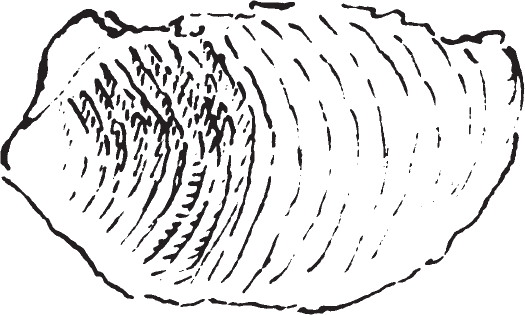 We pushed upstream along the right bank with poles and after a while found Indian hunting huts constructed around thick tree trunks in the tall cottonwood forest. Deschamps brought me a shell impression he had found on the Missouri bank. This region seems to be rich in fossils of this kind.
We put in for a moment at the right bank and then navigated straight across to the left one. Snags and other [obstacles] made the right [bank] not easily accessible. The crew was again put on the cordelle, and they pulled alongside a beautiful tall forest. On the right bank, prairie appeared beyond the forest, where we saw Bodmer and Dreidoppel, shooting at birds. Deschamps went over there in the dinghy. In an old hollow, broken tree, he had hidden a deer he had shot, which was brought aboard. Above the prairie the high, steep hills immediately joined the river. They had 60- to 70-foot-high, steep bluffs, or walls, along which only a few animal paths were to be seen. Just now my hunters also came by here, and they collected interesting fossils down below on the narrow edge of the bank.
The river turned left, and lowlands with a border of willows and forest again lay before the hills, which now receded, that is, continued in a straight direction. Along the left bank where we were navigating lay very much driftwood and many snags, which jolted us. When we glanced ahead along the right bank, just where Deschamps and Dauphin were walking, we saw a big bear, which caught wind of them and ran into the willow thicket. They shot at it twice. We did not yet know whether they hit it. Dreidoppel and Bodmer soon came upon the trail and stayed on it for a while. Among the snags and thick trunks in the water, we put in and loaded the meat of a bison that the hunters had killed on the left bank.
The water of the river was now much clearer than it [had been] before. The higher one gets into the regions with rocky banks, the clearer it becomes. On the left bank the forest came to an end, and mountains with many ravines and scattered shrubs approached the bank. The river also soon turned to the right, and in this way there was always variety. The forest to the right had especially tall, beautiful, slender cottonwoods. Such cottonwood forests probably do not exist anywhere else on our planet. Here we also found many snags along the bank and worked our way through them. To the right the prairie joined steep hills of clay with argillite strata on the bank which were full of interesting fossils. Bodmer and Dreidoppel came over these hills, and the latter was carrying a huge elk antler with twelve points, which he wanted to bring me. Because we had to move on and the antler was heavy, I called out to him to set it up on the elevation so that I could [get] it on the way back. This was done, and the antler could be seen from a great distance. Then they went down to the bank and picked up fossils, mussels, and a fishlike body, the same one Catlin maintained was a petrified snake. Laden with a bald eagle and several interesting birds they had shot, they came down to the willows and into the forest opposite us where the bear had been. They did not find any blood, but they saw that it had vomited all the black berries, so it might have been wounded. Somewhat farther on, we put in for the night in sight of the elk antler that had been planted on the promontory. They sent over the boat, which brought five hunters at the same time to the ship. Mr. Mitchell had been with Culbertson on the left bank and had found [the] very fresh tracks of a large herd of buffalo. They also saw a pack of six to seven wolves, including a white one. The evening was clear and beautiful, somewhat cool.