Journey from Fort Pierre on the Teton River to Fort Union on the Yellowstone River
Stay at Fort Pierre – The Dacotas (Yanktons and Tetons) – The Yellow Stone returns; we travel on the Assiniboine – Difficult voyage – Cheyenne River – Cheyenne Indians – Antelope and elk – Little Cheyenne – Good day of hunting – Moreau’s River – Rivière du Rampart – Two Arikara villages – The Arikara Indians – Cannonball River – Old Mandan village – Heart River – Storms and bad weather delay us – Meeting with the Yanktonais (Dacotas) – Arrival at Fort Clark – The Mandan, Hidatsa, and Crow Indians – Five villages of the Mandans and Minitaris (Gros Ventres) [Hidatsas] – Meeting with the Hidatsas – Little Missouri – Difficult navigation around a promontory – Fire aboard ship – View of the first bears – Two Blackfoot Indians – Meeting with the Assiniboines – First glimpse of the bighorn – Muddy River – Second meeting with the Assiniboines – Yellowstone River – Fort Union
June 14, 1833
Early in the morning, slightly overcast sky; a very powerful, raw wind. At six o’clock we saw a large, white-yellowish wolf on the hills along the bank, trotting beside us about 80 paces away; it was so lacking in shyness that it did not even look back at the roaring steamboat. Dreidoppel shot with his rifle, and it seemed as though he had hit it. Soon another [similar] wolf came along the bank; it had a blackish tail.
The prairie hills were grayish green. Somewhat farther [on,] to the left, along the same bank, [is] a ravine where seven or eight years ago the Arikaras killed five whites who were pulling a mackinaw boat by the cordelle. An extended flat region; the hills round and low, the left bank becoming quite flat. The fierce wind makes it unpleasant to stay outdoors.
At 7:30, 66°F [18.9°C]. To the left, rough, yellow clay bluffs, then a beautiful cottonwood forest with fresh green underbrush; to the right in the distance, several pretty domes. We had passed an island early. At eight o’clock, another recently formed island, which Lewis and Clark did not see. It remains to our left. We continue along the left bank. Thicket of willows, cottonwoods, buffalo berries, roses and other bushes, and also red willows.  To the left in the prairie behind the forest along shore, several rather isolated short, tablelike hills; they are situated close to Cannonball River. To the right, yellow clay bluffs; we are again sailing along this bank. Soon to the left near the bank, a new willow island; sandbars above it, snags and tree branches in the river. Somewhat farther [on], to the right, the forest comes to an end; here along the bank there is a level prairie that extends as far as the hills. On the other side, a wide gap in the hills from which Cannonball River issues. Farther back along its northern bank, several outstanding domes that rise from the plain. The Arikaras call this river Nonátsch-Tiranehúh. Their territory is believed to extend about this far. The Mandans seldom come down so far, unless their war parties roam this far. Along the bank beyond the Cannonball River (it, too, has a steep yellow wall before its mouth on the north side), on its south side [there is] low-lying land with cottonwood and willow. Before we reach the mouth, a shallow spot in the Missouri. We stopped at the mouth; before it, much wood lay in the Missouri. The Cannonball River was high [at this time].
At ten o’clock we were not farther than 60 paces from its mouth. Along its bank and on the left one of the Missouri lay round, yellow sandstone balls that had rolled down; they will have to be more closely examined on our return route. The river got its name from them. Now, along the Missouri, rust-yellow sandstone bluffs follow, and in them there are actually round, reddish yellow stone spheres, perfectly regularly formed, of various sizes: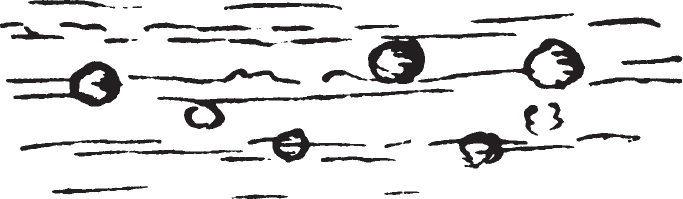 some with a diameter of several feet, but most of them smaller. They protrude halfway out of the steep wall; others have fallen down or have been washed out and lie along the bank. Many are broken in half; most are intact. Many are elliptical or flattened off even more; others are rather convex slabs. Most of them are lodged in the narrow, yellowish red stone layers, which are separated from the yellowish red sand layers by the same crushed stone or sand. These reddish yellow bluffs, or walls, are found on more-inclined areas full of stone debris; in many places, small bushes of buffalo berry and other shrubs as well as smaller plants, particularly Artemisia, grow on them. After twenty minutes ravines appear with thickets in them. A half hour beyond the mouth of the river I no longer noticed any spheres. At noon, 71°F [21.7°C].
About 12:30 we put in at the right bank near a narrow border of prairie forest and cut wood. Here Tradescantia virginica, with its red flowers, grew abundantly, [as did] a beautiful, tall plant we had not seen [before] with leaves as thick as those of a cabbage [and] beautiful big lilac flowers [— —]. Their seedpods no longer contained any seeds. Caprimulgus americanus (nighthawk) flew about, probably roused by the woodcutters, and there were numerous redheaded woodpeckers. Cornus sericea grew very abundantly here; many of its trunks were cut off to make kinnikinnick. About this time a very black mass of clouds rose on the southwest horizon; it soon thundered and rained. One of our boilers needed repair; we will probably have to remain here a long time.
About three o’clock we went out onto the prairie, and in the grass and in various bushes at the beginning of the prairie, we immediately found the beautiful ricebird (Icterus agripennis Bonap.) The male has very beautiful black and white and melon-yellow plumage; the female has a very plain, lark-gray coat that is yellowish underneath. They are not shy, climb about on the grass blades and tall plants on the prairie, and alight on the tops of bushes. The beautiful male spreads his tail and wings and when driven off lets his pretty song be heard in flight. Besides these birds, I found in the thickets the catbird, the kingbird, Muscicapa crinita, the large yellow-breasted lark whose song is heard everywhere, and several additional small birds. There were no larger animals in the vicinity; furthermore, too many of our people had gone out in all directions onto the prairie. Bodmer and Dreidoppel had also gone out; they brought back only some plants. We stayed here [all] evening and [all] night. Slightly above us [and] to the right, a creek emptied, which Lewis and Clark named Fish Creek (Shewash) on their map. The water level of the Missouri rose more and more; the evening was pleasant, sunset very beautiful. [All] evening and [all] night, men had to fend off with poles the large trees that the river washed down; nevertheless, we received such jolts throughout the whole night that the entire ship trembled.