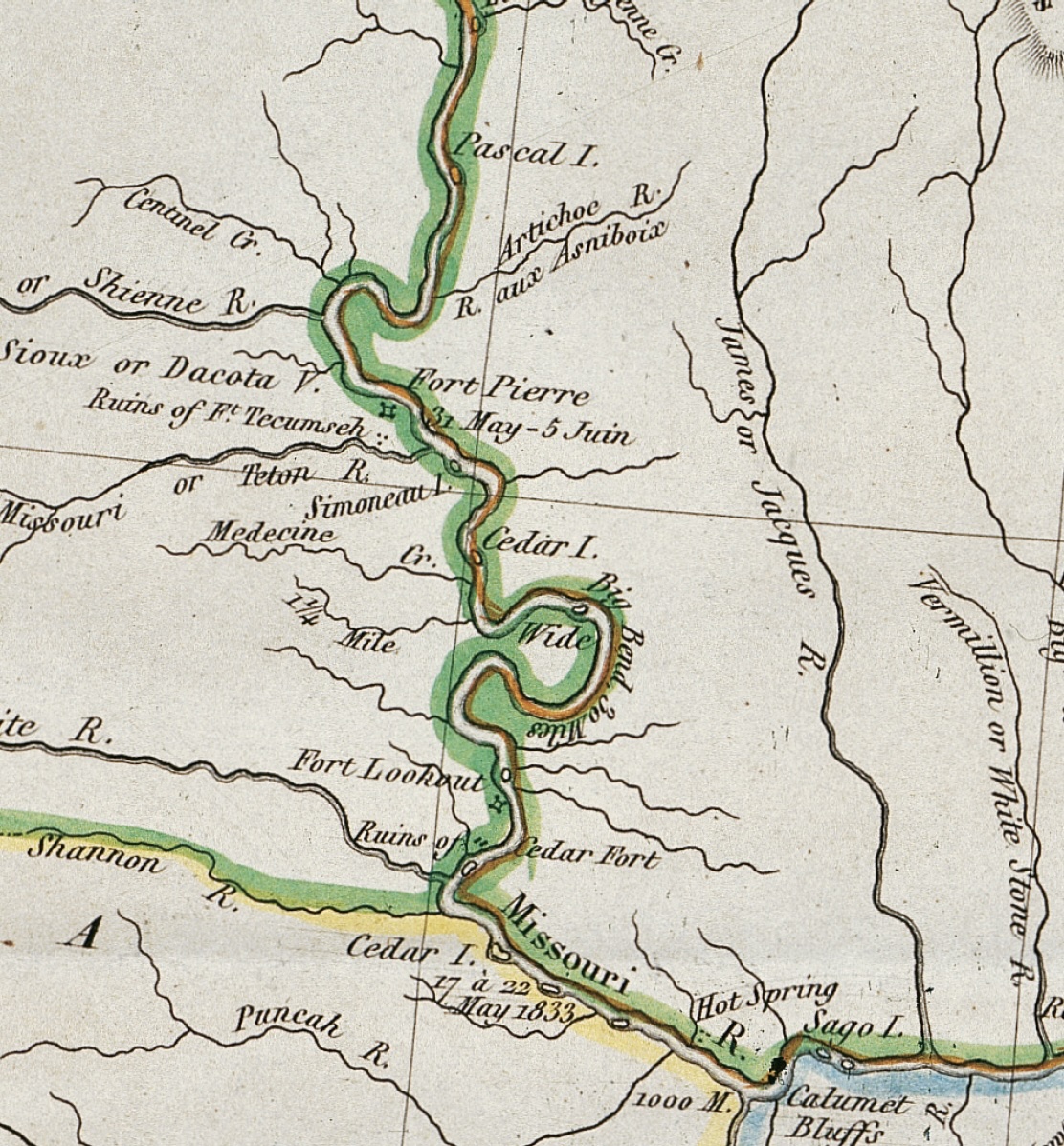
Journey from Fort Pierre on the Teton River to Fort Union on the Yellowstone River
Stay at Fort Pierre – The Dacotas (Yanktons and Tetons) – The Yellow Stone returns; we travel on the Assiniboine – Difficult voyage – Cheyenne River – Cheyenne Indians – Antelope and elk – Little Cheyenne – Good day of hunting – Moreau’s River – Rivière du Rampart – Two Arikara villages – The Arikara Indians – Cannonball River – Old Mandan village – Heart River – Storms and bad weather delay us – Meeting with the Yanktonais (Dacotas) – Arrival at Fort Clark – The Mandan, Hidatsa, and Crow Indians – Five villages of the Mandans and Minitaris (Gros Ventres) [Hidatsas] – Meeting with the Hidatsas – Little Missouri – Difficult navigation around a promontory – Fire aboard ship – View of the first bears – Two Blackfoot Indians – Meeting with the Assiniboines – First glimpse of the bighorn – Muddy River – Second meeting with the Assiniboines – Yellowstone River – Fort Union
June 18, 1833
In the morning, gloomy sky, damp, light wind. To the right in the prairie, the hills along the bank were bare [and] low; to the left and before us, even lower; here and there, a green forest border along the bank. In the distance we saw the Dacotas following us over the hills on the right bank. Swallows nest on some small bluffs on the left bank. It was about 12 miles [to] the Mandan villages [from the place] we had the meeting with the [Dacota] Indians. On the hills to the right there were ten to twelve wolves together. A roundish willow island remains to our left. At 7:30, 63°F [17.2°C]. To the left behind the alluvial deposits, again several more series of flat-topped hills. To the right around the bend, a large accumulation of sand with willows, the sand in large part still quite bare. We halt to the right at the (sand) deposit and cut (wood.)
As one approaches the Mandan villages, one has hills to the left, table-shaped on top; [just] in front of these are others, [very similar,] fronted by strange isolated conical hills. To the left, in the willows on the bank [are] the winter lodges of the Mandans, now mostly dilapidated. In the winter these Indians move into the forests and thickets for better protection against the cold. The winter lodges are smaller than the summer lodges. One saw the villages in the distance, and the whole prairie [was] covered with men on horseback and on foot. As we came closer, [we had an] attractive view of the reddish village with the fort [silhouetted] against the dark blue-green hills. The American flag waved on top of the fort. [There were] four white men on horseback on a prairie point of land to the left [and] several Indians sitting in their robes. Cannon and gunfire. We landed at a rather high bank on top of which Fort Clark is located. [It was] built as a square, in the same manner as Fort Pierre, but scarcely half as large.
A population of at least two hundred to three hundred Indians stood and sat on the bank, including highly characteristic, tall, handsome men. Their leather blankets [were] mostly reddish brown on the flesh side, whitish in a few cases; they also had many woolen blankets. Assembled here were Mandans, Hidatsas (Gros Ventres), and about seventy leather [tipis] of the Crows (Corbeaux). The latter had only recently arrived from their distant habitations, because their subagent, Mr. Sanford, had informed them of his forthcoming arrival.
 In dress, these three nations differ little. They wear their hair long, in some cases hanging down over the hips, cut off bluntly on and beside the forehead, above the eyes, and on the cheeks but divided in back into many flat, broad queues, which are kneaded with white or reddish brown clay; this hair hangs down long and is usually lengthened with cutoff human hair. On their heads they wear as many feathers as enemies they have slain, in natural colors or with yellowish [or] reddish brown transverse stripes. These feathers often hang down in back like a fan. Others had headbands of otter around their heads or had bound their hair together in a thick knot. In their ears they wear strings of glass beads and, frequently, above each corner of the forehead, a similar long, often ribbonlike pendant fastened to their hair, which hangs all the way down to the chest on some of them. Necklaces made from grizzly bear claws were not uncommon. These they value highly and would [only] give them up for a gun or a horse at the very least.
 Their bodies were mostly naked, painted dark reddish brown for the most part, their faces vermilion. [They had] iron bracelets and broad rings of iron—also, many of brass, such as most Indians wear. Their leggins and leather jackets were decorated in the manner of the Dacotas, and their buffalo hides, on the reddish brown or white flesh side, [were] decorated with [either] all kinds of colorful figures of men and animals or merely with arabesques.
 Many of them were mounted: a saddle like the Hungarian seat, the bridle color-fully decorated with cloth. The stirrups [were] like Turkish ones and covered with leather. Their bows [were] like those already described, but I saw a very big one [with] a lance on top, the whole weapon decorated with feathers and colorful cloth. Their quivers and bow sheaths were made of hide. Most of them carried battle-axes, beautifully and colorfully decorated on the handles. From Mr. Bodmer’s sketches much will become clearer.

 Several chiefs and distinguished men soon came on board, [including]
the principal chief of the Mandans Mató-Tópe Cháratä-Numakschi and Mató-Tópe from Mih-Tutta-Hangkusch, and still other [all] distinguished Indians. They sat around in the small cabin, and the old interpreter of the Hidatsas (Gros Ventres), Charbonneau, told them about the Dacotas we had seen yesterday, who wished to make peace. For a long time the chiefs discussed the matter pro and contra; they agreed, however, that [although] they did not want to disturb them now, an agreement was out of the question, because those Dacotas were very unreliable people.
All the Indians in our cabin were powerful, tall, robust men. They carried war clubs or tomahawks in their hands, [and] a few even had guns; an Indian never goes anywhere without his weapons. In their hands most of them carried eagle fans covered on the bottoms with red cloth. They wore on their heads such a mass of long hair [that it] must be very troublesome during the summer (and heavily populated besides). It appeared [to have] never been thoroughly combed. Over [their] hide blankets, some carried bows and arrows in quivers; others, powder horns and bags (if they had guns). On horseback they always had whips in hand, because they do not wear spurs. Many carried guns fastened by ropes, with the butt pointed up and forward and the barrel pointed down and backward.
 This is the way they often ride on small, poor horses but often, too, on very handsome, impressive ones of all colors—then they show a certain resemblance to the Bashkirs, though they are more handsome, have more finery, and are more beautifully attired. It was a noteworthy sight to see these chiefs speak with gesticulations [signs] unique to the Indians and understood by all nations, by means of which they make themselves understood everywhere.

 Behind the fort were seventy leather lodges of the Crows, or Corbeaux, whom I visited in the afternoon They were entirely like [the lodges] of the Dacotas, but one could see small pennants of colored material on top of every single [tipi] pole. I did not see any scalps here. A striking sight in this camp were the packs of large wolflike dogs of all colors, certainly three to four hundred. Barking and howling, they attacked me, and I could scarcely reach the [tipis].

From here I went to the village of the Mandans, which was built northward along the river on the high bank, 300 paces away from those [tipis].
 Here I have described just one side of the fortifications. Here, too, many dogs ran about, and [with] in the outside palisades are located the large earth lodgings with this shape and an opening on top for smoke; [the opening] is covered with a basket like a lid made of twigs. The lodges stand about in no definite order; from time to time people sit or stand on [top of] them so that they can see far around. In this village there are about sixty-five lodges. Three miles away is located the second village of the Mandans, with about thirty-eight lodges. In the former the chiefs are Cháratä, in the latter, Kähka -. These are all the Mandan villages. The Hidatsa (Gros Ventre) villages, three in number, are located several miles from here. Most of their inhabitants were at the fort today. Outwardly they do not differ from the Mandans, but their languages are different.
We had a most interesting view on the flat prairie around the fort and the village. A large number of horses grazed everywhere. Indians of all ages and both sexes on horseback and on foot moved back and forth; the brown, often reddish brown, black-haired figures in colorful dress and faces painted red are most singular. In addition to them, we saw tall poles erected near the villages, on top of which various objects such as cloth, hides, and the like were suspended: medicines, as the Americans call them, or superstitious protective or sacrificial devices. [Also] over the whole prairie and beginning just a few hundred paces from the [tipis are] numerous scaffolds for the dead on which [are laid] bodies wrapped in hides.
Having returned to the ship, I found a horde of Indians on board. All our acquaintances were there; they smoked, talked, and lay sleeping, wrapped in their blankets, around the fireplace. Near the village a crowd converged; one of the Indians from the peace-seeking Dacota band had been brought over from the other side in a hide canoe [bullboat]; he was half Mandan. In the evening the agent of the Crows, Mr. Sanford, had a discussion with the chief of this nation, Eripuáss (Rotten Belly), an important man with a good-natured physiognomy. He had cut off his hair, was wrapped in a miserable old woolen blanket, and had smeared his face, since he was in mourning. Mr. Sanford counseled the continued good treatment of whites, hung a medal around his neck, [and] gave him a fine present of cloth, powder, and tobacco on behalf of the government. He accepted all this without the slightest sign of gratitude.”
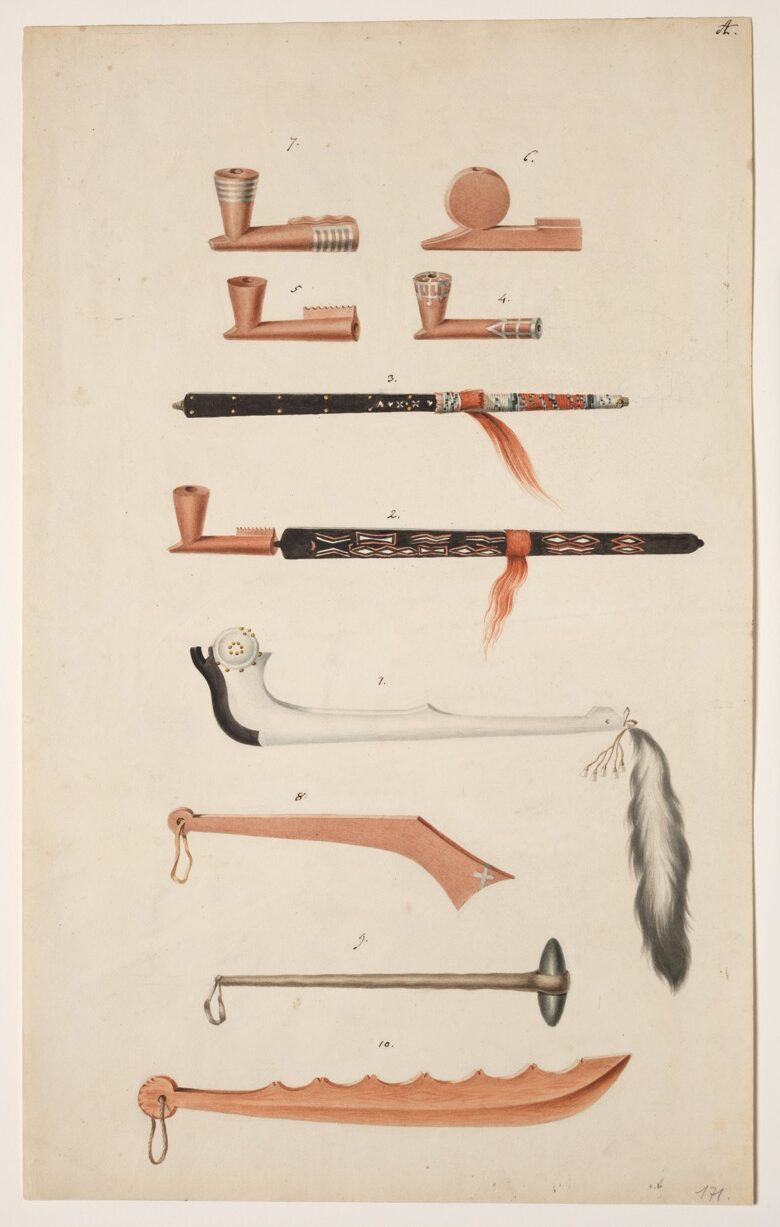
Afterward, when it was already dark, we visited him in his [tipi] with the old interpreter Charbonneau. The whole camp was filled with a large number of horses standing around in the open, some of them with their foals. Some of the dogs had already gone into the lodges, but there were still enough of them to bark at us. Inside the lodge there was an interesting sight. A small fire was burning in the middle. The chief sat opposite the small door. All around [were] as many men as could find room, depending on their rank, all naked, only scantily covered with their breechcloths. After we had seated ourselves on buffalo hides (on his left side), the chief lit the long Dacota pipe of red stone, decorated with pewter and with a long black stem studded with yellow nails, and let each of us take a few puffs while he held the pipe. Then he passed it around, and it circulated in this manner until it was finished. With the help of the interpreter, who speaks only the Hidatsa language, we talked with this chief and then returned to the ship without taking leave, as is always the case with the Indians (except that one shakes hands with the host).

Today we had also seen two Arikaras and a Blackfoot Indian. The former were exceptionally tall, heavy, broad-shouldered men, the latter slender and slight with not unpleasant features. Today the gentlemen of our group experienced the readiness with which the Mandans and Hidatsas offer their wives and daughters; several of us were approached twenty times, and men even came and offered [their] wives. No other Indian nation is believed to approach these three [sic] mentioned here in this respect; exactly the opposite is true of the Dacotas. The Mandan women are said to have a peculiarity in their physical structure like that of the Hottentots in Africa.
The Mandans live in two villages on the bank of the Missouri and can put 250 to 300 warriors in the field. They themselves call their nation Sipuska Númangkake (‘mang’ as in French), that is, Les gens du [illegible] “people, human beings.” The names of their two villages are Mih-Tutta-Hangkusch (‘Mih’ stressed, ‘Tutta’ without stress, ‘ang’ as in French) for the first one, where we were yesterday, and Ruhptare (‘e’ fully pronounced) for the second, smaller village. In the first village, the principal chief is dead. The second one, who was with us, [is] a tall, strong, impressive man. His name is Cháratä-Numakschi (‘Ch’ velar), that is, (— —). In the second village, there are two chiefs. As mentioned, they live in comfortable, secure earth lodges, which are permanent. Most also speak the language of the Hidatsas (Gros Ventres), although the latter do not speak that of the Mandans. They plant corn and hunt the numerous buffalo, deer, and antelope. The origin of this tribe is unknown. They are enemies of the Dacotas and the Arikaras. Their language is different from the others. More information will follow later, in the next volume of this diary, in connection with our winter sojourn at Fort Clark.
| Language Samples of the Mandan or |
|
|---|---|
| WORDS | |
| Sun | Maháp-míhnankä (‘an’ as in French) |
| Moon | Istú-menáhke (first ‘e’ half [=ə], second full quality) |
| Star | Chkäkä (‘Ch’ velar) |
| God | Ómahank-numáhkschi (half loud and short) |
| Fire | Wǻradä (last ‘e’ somewhat short [sic]) |
| Water | Mönníh (‘ö’ short like the whole word). Many say Mönnih. |
| Earth | Máhhankä (‘an’ as in French, ‘kä’ short and soft) |
| Man | Númangkosch |
| Woman | Míh-hä (‘hä’ short) |
| Child | Suck-chámahä (‘ch’ velar) |
| Head | Pá |
| Arm | Áh-dä (‘dä’ short) |
| Hand | Ung-kä́ (‘kä́’ short) |
| Hair | Pa-hín (‘n’ as in French) or Pa-hí (‘hí’ is a nasal sound; sounds like ‘hin’) |
| Eye | Istá |
| Mouth | Íhhä (together, ‘Íh’ stressed, ‘ä’ short) |
| Bow | Woraërúhpa (‘r’ tongue trilled) |
| Arrow | Mánna-máhhä |
| Pipe | Íhingkä |
| Tomahawk | Ohmanatt-chamahä-ihingkä-tuhsch |
The Hidatsas (Gros Ventres) themselves call their nation Enásach (‘ch’ velar) or Les gens des seuls Biddahátsi-Awatíss. They live several miles from the Mandans in three villages. The first is now called Eláh-Sá (Grand Village), the second Awaticháy (‘ch’ velar, [‘ay’] together), the third Awacháwi (Shoes). They got the name “Minatarris” from the Mandans. They are said to call themselves Bellantsiä is not so according to Charbonneau’s statement who has lived long among them, which, however, is not correct. They are even more handsomely built than the Mandans, particularly the women, among whom we saw many very pretty ones, with vermilion faces from which their eyes gleamed, snow-white and black. Their dress is especially beautiful and richly embroidered with beads and feather quills of the most vivid colors, with a large number of braids and strings of leather and hair. The Crows are said to outdo even them in this respect. They number about 350 warriors and live along the Knife River, especially, but their villages are not located directly along the Missouri. They are friends of the Mandans, their close neighbors, but enemies of the Arikaras and Dacotas. Their language differs entirely from that of the Mandans. I will now provide the following words:
| Language Samples of the Minatarris [Hidatsas] (Gros Ventres) | |
|---|---|
| WORDS | |
| Sun | |
| Moon | Waachkuwiddih |
| Star | Aechká (‘ch’ velar) |
| God | Ehsichkawahiriss (‘ch’ as in the German ‘ich’) |
| Fire | Biddah (short) |
| Water | Biddí |
| Earth | Awá (short) |
| Man | |
| Woman | |
| Child | Mahkarisächta |
| Head | Aach-tú (‘ch’ barely audible, ‘tu’ short) |
| Arm | Ahra (‘r’ tongue-trilled, ‘a’ barely audible) |
| Hand | Schahgi (‘gi’ velar, short and soft) |
| Hair | Ará (‘r’ tongue-trilled, ‘a’ short and half) |
| Eye | Ischtá |
| Mouth | Ehi-ï (together) |
| Bow | Berúcha-páruwi (‘wi’ short) |
| Arrow | Aroh-síschah (‘a’ always muted) |
| Pipe | Éh |
| Tomahawk | Uehpsa-naka-ehgipi |
Note: Since some of these language samples are incorrect, I have provided a more correct list in the form of a supplement on [manuscript] page 312.
They have many velar sounds, though not unpleasant ones, [and] therefore a German can very easily write and pronounce all these languages if he makes use of the French ‘an’ and ‘on.’ The ‘a’ is seldom pronounced clearly.
The Crows (les Corbeaux) call themselves Apsáhrukä. Continuation about the Corbeaux in the note:
[They] live along the Yellowstone River, as their northern boundary, up to the Rocky Mountains and on the other side as far as the Cheyennes and the Gros Ventres (Hidatsas). Six years ago they numbered 1,000 warriors; now [there are] about 1,200 [warriors] and 6,000 people in all. They roam, hunt buffalo and all kinds of game, live in leather [tipis], have many dogs (which they do not eat), and very many horses, more than the Missouri Indians They make very fine garments from bighorn hides. [They] make war on the Cheyennes, Blackfoot, and Dacotas. They are friends of the Mandans and Hidatsas, whom they seldom see, however. They trade horses with the latter for European goods. [They] have extremely many dogs. They are well-built, powerful men, with slightly aquiline noses, like most Indians, and wear their hair long and hanging down, like all the northern Indians. Their language is related to that of the Hidatsas. The Dacotas and the Assiniboines call them Kanché-uïtschasche (‘ch’ velar, last ‘e’ half [= ә]). The Crows are proud Indians men who despise the white man more than all other Indians, yet in their [tipis], they are very hospitable toward them and treat them very well. They have their trading post at Fort Cass on the Yellowstone River. Everything they make is attractive and well made; their weapons as well as their leather costumes [are] very fine. From the horns of elk and bighorns, they make bows that one does not see among any other tribes. They also cover [these] with snakeskins, just as I saw among the Piegans. See their warbonnets and those with horns in the illustration [perhaps fig. 9.5]. Among whites they are big beggars and very thievish as well. Their language is almost identical with that of the Hidatsas.
| Language Samples of the |
|
|---|---|
| WORDS | |
| Sun | Aachkasse (‘Aach’ as in German, ‘e’ full quality) |
| Moon | Minitatse (‘e’ full quality) |
| Star | Ichkä́ (‘ich’ as in German) |
| God | Mah-komazätze (‘e’ half [=ə]) |
| Fire | Birä́ |
| Water | Minä́ |
| Earth | Puchkä́ (‘Puch’ velar as in German) |
| Man | Machpáhpeh (‘ach’ velar) |
| Woman | Mehekaat |
| Child | Makaat |
| Head | Orä́ |
| Arm | Aáh-neh |
| Hand | Istschö́ |
| Hair | Ahsóha (final ‘a’ short) |
| Eye | Estö́ (‘Es’ short, ‘e’ only half [=ə]) |
| Mouth | Hóhmo |
| Bow | Histáchä (‘ch’ velar) |
| Arrow | Anohte (‘e’ half [=ə]) |
| Pipe | Nehpitzi (final ‘i’ almost like ‘e’) |
| Tomahawk | Mahtzipe (‘e’ full quality and short) |
Note: Because these language samples of the Crows are partially incorrect, I have provided a corrected list on p. 312 of this volume in the form of a supplement.