Journey from Fort Pierre on the Teton River to Fort Union on the Yellowstone River
Stay at Fort Pierre – The Dacotas (Yanktons and Tetons) – The Yellow Stone returns; we travel on the Assiniboine – Difficult voyage – Cheyenne River – Cheyenne Indians – Antelope and elk – Little Cheyenne – Good day of hunting – Moreau’s River – Rivière du Rampart – Two Arikara villages – The Arikara Indians – Cannonball River – Old Mandan village – Heart River – Storms and bad weather delay us – Meeting with the Yanktonais (Dacotas) – Arrival at Fort Clark – The Mandan, Hidatsa, and Crow Indians – Five villages of the Mandans and Minitaris (Gros Ventres) [Hidatsas] – Meeting with the Hidatsas – Little Missouri – Difficult navigation around a promontory – Fire aboard ship – View of the first bears – Two Blackfoot Indians – Meeting with the Assiniboines – First glimpse of the bighorn – Muddy River – Second meeting with the Assiniboines – Yellowstone River – Fort Union
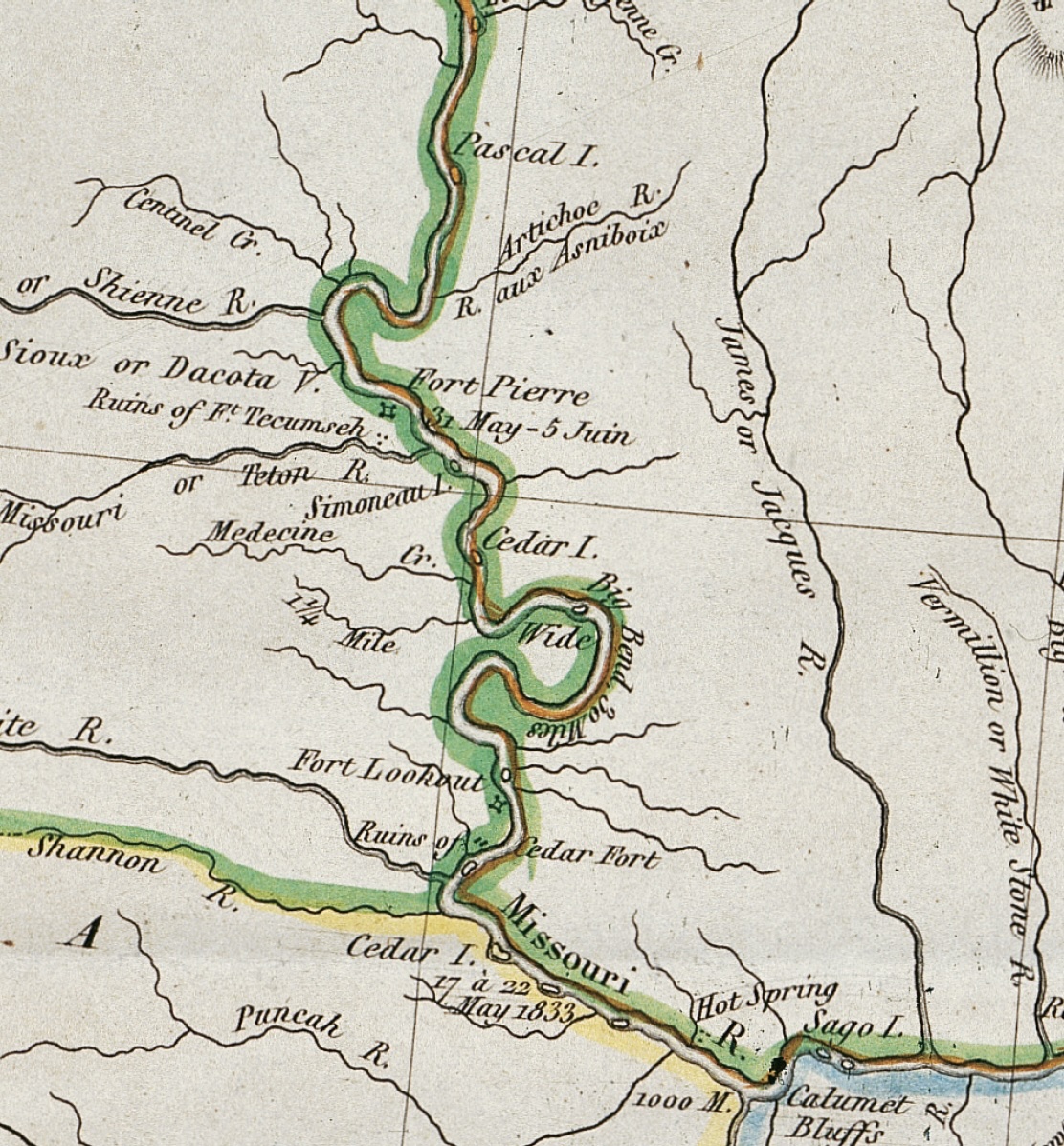
June 20, 1833
In the morning, some sunshine, cool, wind. Early, we met about fifteen Indians on the right bank in the forest and saw four elk beyond them. Beautiful hills on the left bank; they were spotted green from the bushes, gray and dark green. In general the region is rather flat, the hills low; to the right, everything covered with yellow grass. To the left the hills are higher; before them lies the forest, behind them, the elevations. 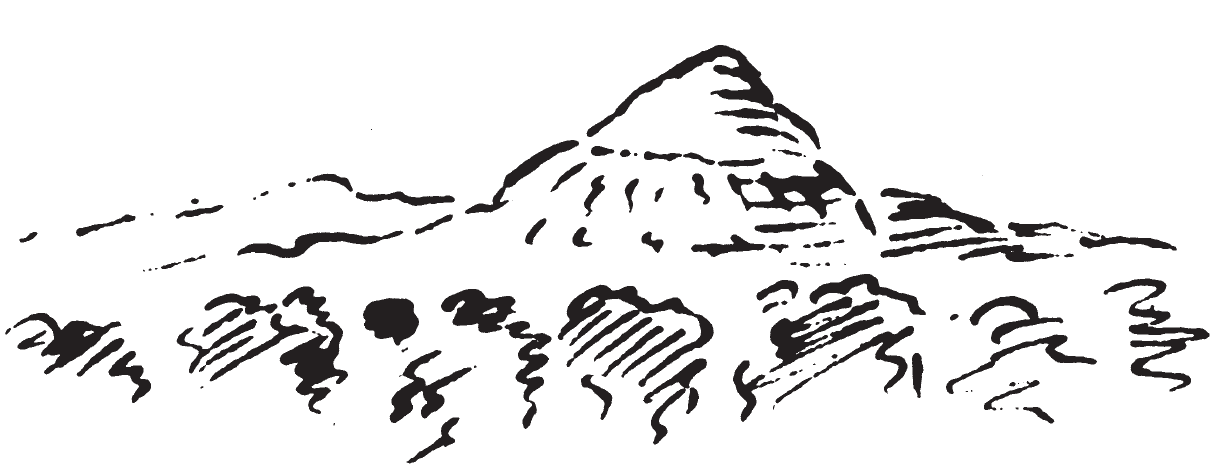 Farther away, a place where bituminous coal deposits had burned; the ground [has] caved in, [and] now one no longer sees smoke. Farther away on the point of land, a Hidatsa village once [stood]. To the right the hills again have distinctive shapes, like last evening; cones stand in front of the hill range; before it in some places there is forest with many withered cottonwoods. At 7:30, 64°F [17.8°C].
At ten o’clock we tie up at the left bank near a sparse, tall forest to cut wood. Bodmer and three other men went hunting, intending to return to the ship farther upstream. Extremely strange hills behind the forest; they are flattened off on top and bear the name l’ Ours qui danse, because, as people say, here the Indians held the bear dance, a medicine festival, to ensure good hunting. To the right, at the bend of the river, a wide bar with white sand. At twelve o’clock, 70°F [21.1°C]. The wind is now very strong again and raw.
After one o’clock we reached a bend of the river to the left. Here it is broad and magnificent, the region [being] flat; on all banks, green borders of forest continue for a long time. On the right bank the forest is beautiful, tall, and dark; to the left it is more like lowland, with willows. On this bank there are many traces of beavers: gnawed-off trees and paths to the water. Our hunters gradually put in their appearance on the bank; they had killed two Virginia deer, an antelope, and a prairie hen. Bodmer returned flushed; he had to run a great distance to reach the steamboat.  His catch was an
old Indian stone axe; he had found it in the prairie. While the hunters were being taken aboard, the wind drove the steamboat so close to shore that the crew had to work a long time before it was afloat again.
About one and a half hours later, we reached a pretty brook that enters the Missouri to the left from a broad, beautiful valley. It seems to have not received a name from the whites. Farther on, to the left, [are] gray clay bluffs; in the middle, a black longitudinal streak, probably argillite. Willow and cottonwood forest opposite them. To the right, barren, bare hills follow along the bank, the turf of which appears almost ash-gray, completely devoid of life. Because in general it has rained little, the continuing winds have parched the land to an extraordinary extent. Here and there intermittently, woodland along the shore. Toward evening one saw to the left, on a grassy clearing in the forest, four buffalo, which quickly hurried toward the thicket.
Extremely odd elevations, cones, and pyramids again followed on the hills; on the right bank, too, they made their appearance, like haystacks, one in front of the other. Here and there [were] ranges of hills flat on top, before which were conical peaks; they all rose above the forest along the bank. Toward dusk, after we had several times been driven by the current against the bank, we put in at the right bank and fastened the ship to several trees. Everywhere in the nearby prairie were fresh and deeply trodden buffalo trails; however, we saw none of these animals. In the ravines were bushes; here and above the bank flew Caprimulgus americanus. An eagle’s nest on a nearby tree seemed to be unoccupied. At dusk we went for a walk; the evening was beautiful but cool, the grass very wet from the dew, a fact that let us conclude that there would be good weather.