Journey from New Harmony on the Wabash to St. Louis on the Mississippi and Stay There
Mount Vernon – Shawneetown – Cave-in-Rock – Mouth of the Wabash – Cumberland and Tennessee River – Mouth of Ohio – Mississippi – Commerce – Cape Girardeau – Grand Tower – Devil’s Bake Oven – Kaskaskia River and Indians – Ste. Genevieve – Selma – Herculaneum – Merrimac River – Jefferson Barracks – Vide Poche – St. Louis – The Sauk (Sac) and Meskwaki Indians1 – Black Hawk – Meeting with the prisoners – Preparations for continuing journey

March 17, 1833
Overcast sky indicates rain. After breakfast Mr. Bodmer went hunting for birds and frogs. It was Sunday. The stout clergyman, who was living in one of the downstairs rooms with his family, conducted a short devotional service. He led the singing from a hymnal by open windows. His wife joined in as she washed her children.
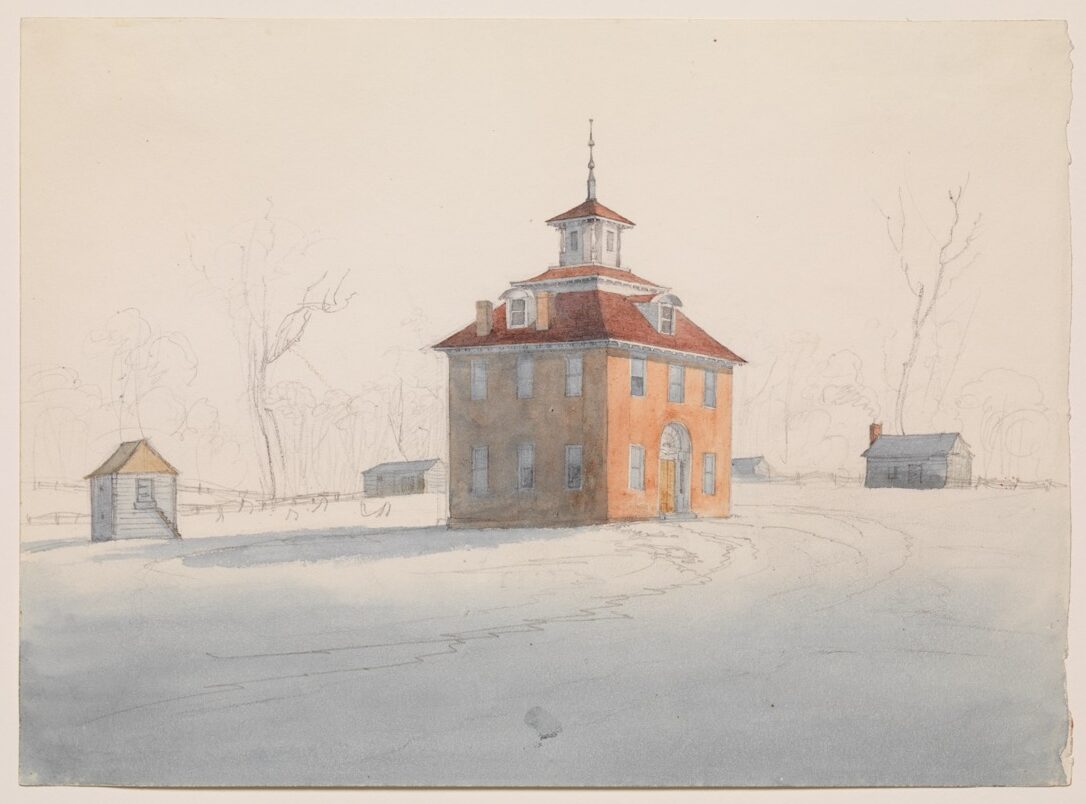
I went into the courthouse, which is always open, and paced off the interior. The building has two stories. On the ground floor is the session chamber, with three windows, [measuring] 14 steps on each side; it is thus a square (see Mr. Bodmer’ s view of it). On the upper floor there are wooden partitions, which divide it into various rooms, some with fireplaces. The doors to all the rooms were open. Recently a long court session lasting several weeks had been held here.

We visited the forests immediately surrounding the town; [they] are situated on low ground and are therefore full of swamps and puddles, into which we sank deeply. The small tree frogs mentioned yesterday were chirruping everywhere in the puddles, but we could not catch any. On the other hand, we did find a [toad, a] Bufo clamosus with large thick parotids. The birds—woodpeckers, titmice, and several finches—let their spring voices be heard. Quite recently in Harmony, a burned garter snake (Coluber sirtalis) was found when the grass in the graveyard was set on fire. The amphibians are gradually awakening now. At noon it was oppressively warm. At twelve o’clock, 14°R (63.5°F, 17.5°C).
After lunch a steamboat was seen (from here one can see upriver for a distance of 8 miles, as far as Diamond Island). The German joined us. We went to the river. There were several flatboats laying at anchor here; also, several were coming down the river but had the harsh wind, which had arisen, against them. This raw wind had dispelled the rain.
As we were conversing with a little French doctor—after Napoleon’s misfortune, he had visited the West Indian islands and New Orleans—a kingfisher passed over our heads and flew up Mill Creek, which empties directly below the town. Mr. Bodmer pursued it with the shotgun. Fardins Creek also empties directly above the town. Two flatboats lay at anchor here with 90 horses, which stood unprotected and crowded very close together, waiting for steamboats to take them away. [A price of] 500 and 400 dollars had already been demanded for towing them as far as New Orleans, but this was too much for [the shippers]. Pigs run around everywhere in the streets. Pigs and corn compose the wealth of the local planters. At any moment one sees scenes in the streets where hogs simply lie down and suckle their young. Much pork and corn are shipped from here down to New Orleans.
[After] the steamboat sailed upstream and vanished from our sight near Diamond Island, we returned. That island is large; it is said to comprise 1, 100 acres of land, entirely uninhabited but with good hunting, as is generally true of all the woodlands in this region, [where] wild turkeys and deer abound. A deer with three points was recently shot in this area. Our housemates had gone to the meeting house. There is no pastor here, since the local sects have no need of one.
Years ago, and until 1810, a tribe of the Meskwaki Indians lived in Mount Vernon, that is, in this region. They were not numerous and stayed especially near the mouth of the Wabash and along Big Creek. They were strong, handsome people, with breechcloths, bows, and arrows. Their band had about 30 to 40 shabby guns. They were experts with the bow. Their huts at the mouth of the Wabash were built of thick bundles of cane and lined on the inside with deerskins. They smoked sumac leaves in wooden pipes with stems made of cane. Many also had their pipes on their tomahawks. Their heads were shorn except for a tuft of hair in the middle of the head. They painted themselves red.
I spoke with one of the first planters, or settlers, of this region, who had grown up among Indians in Tennessee and Kentucky but had moved in 1806 into the woodlands along the Wabash, where there were then no white people. The year before the battle of Tippecanoe (1809), the Indians left this area and never returned. They were peaceful toward the white people, visited those first settlers, and encamped around their fires, especially during bad weather. At the time when that man was settling, there were still elk and beaver here, though no longer numerous. But there were bears and wolves in large numbers. He shot many bears and very many turkeys. These birds lay up to sixteen eggs, which have a slightly more reddish color than those of domestic turkeys. Now, in the middle of March, these birds are very fat and will soon start gobbling.