Journey from Fort Pierre on the Teton River to Fort Union on the Yellowstone River
Stay at Fort Pierre – The Dacotas (Yanktons and Tetons) – The Yellow Stone returns; we travel on the Assiniboine – Difficult voyage – Cheyenne River – Cheyenne Indians – Antelope and elk – Little Cheyenne – Good day of hunting – Moreau’s River – Rivière du Rampart – Two Arikara villages – The Arikara Indians – Cannonball River – Old Mandan village – Heart River – Storms and bad weather delay us – Meeting with the Yanktonais (Dacotas) – Arrival at Fort Clark – The Mandan, Hidatsa, and Crow Indians – Five villages of the Mandans and Minitaris (Gros Ventres) [Hidatsas] – Meeting with the Hidatsas – Little Missouri – Difficult navigation around a promontory – Fire aboard ship – View of the first bears – Two Blackfoot Indians – Meeting with the Assiniboines – First glimpse of the bighorn – Muddy River – Second meeting with the Assiniboines – Yellowstone River – Fort Union
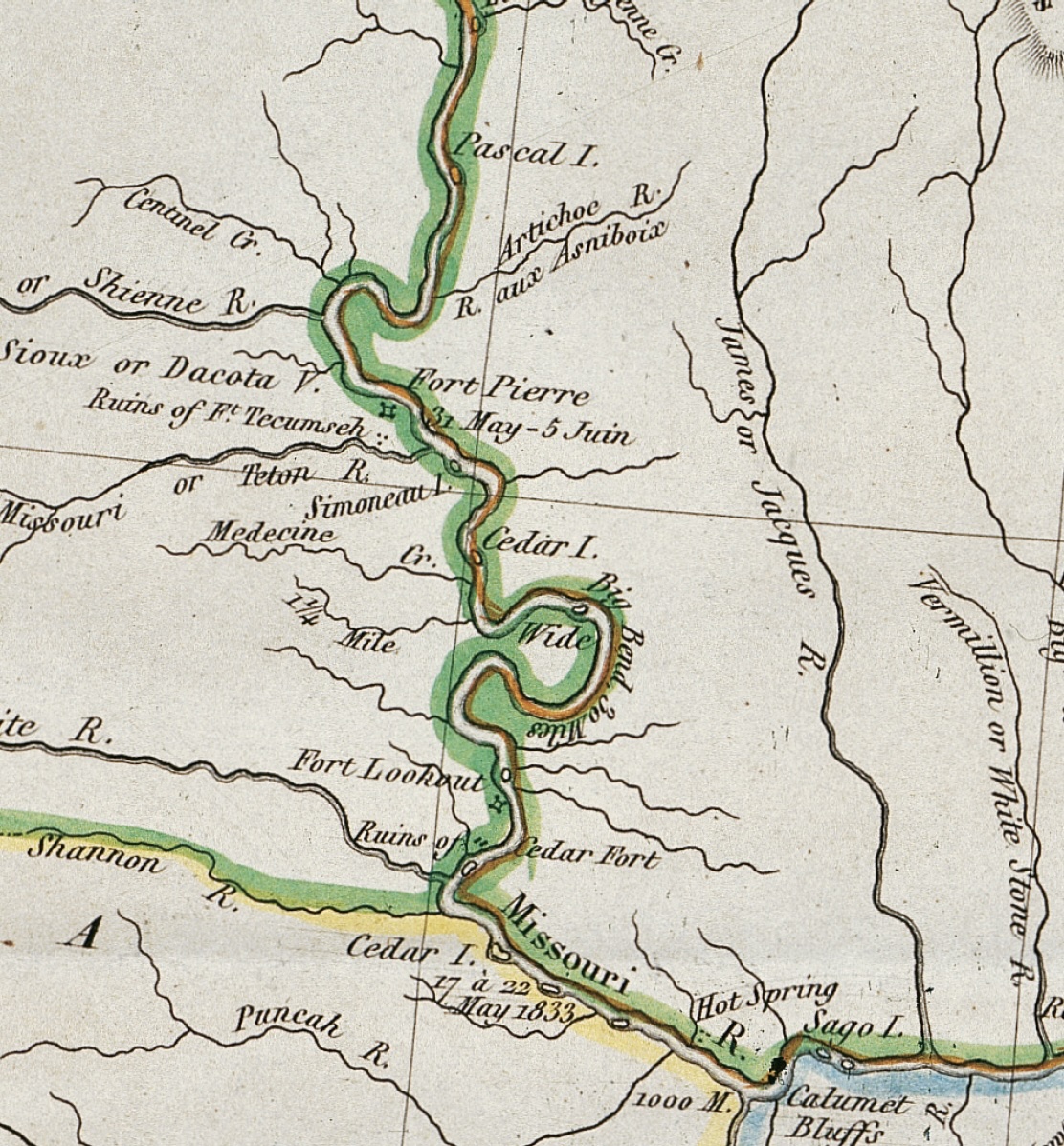
May 31, 1833
 In the morning, cool, somewhat windy weather. The Assiniboine arrived and anchored on the riverbank opposite us. Indians and whites filled the ship early.
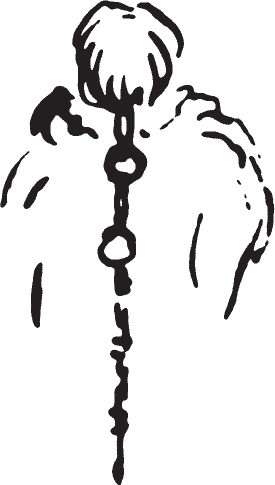
Among the men we saw one with a light yellowish color; he had red streaks on his face; the area around his eyes was red. Others were painted white around their eyes. Many had braided their hair into a long queue in back, which was adorned with metal rosettes and colorful ribbons and hung far down. Several had wooden war clubs painted white; most of them had bows and arrows and a quiver of hide or tanned leather over the shoulder. Very few wore feathers in their hair.
An old, half-consumptive man came to visit us, since he was a comrade of Little Soldier’ s. He wore a wolf’s hide for a cap with the tail around his head. The women had their hair parted, with the part painted red. Their hair hung down naturally; several wore beautiful, tanned, and very well painted (red, black, and yellow) hides; others had their leather outer garments broadly edged and very neatly stitched with sky-blue beads.
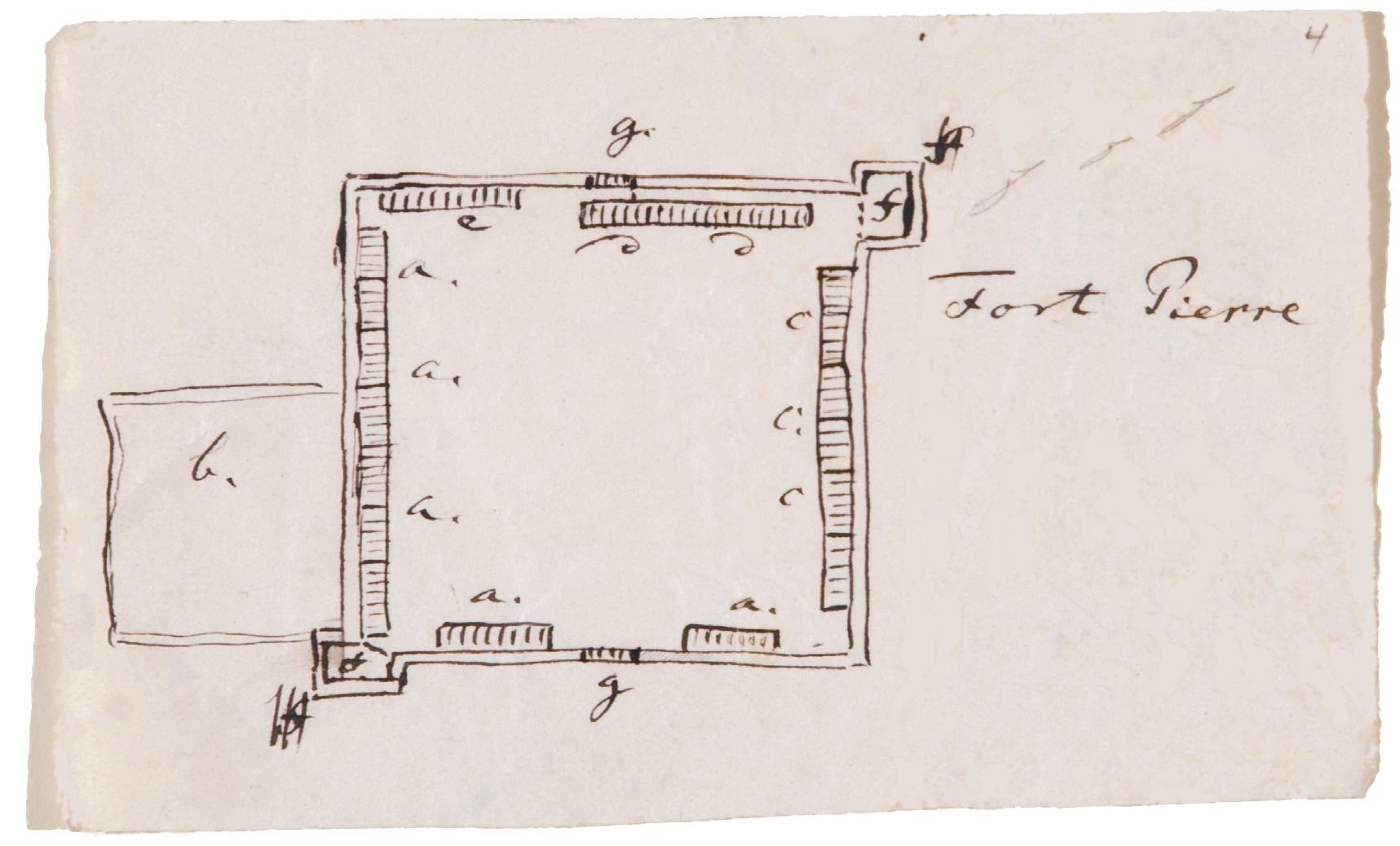
 I visited the fort and their [tipis]. This fort measures [— —] paces in a square around its outer plank enclosure and is built entirely of wood, which had to be brought from 40 to 60 miles downriver, since little timber grows in the vicinity. On the inside the buildings are arranged in a square, and in the western corner there is a blockhouse with firing slits and two tiers that commands two sides. On the diagonally opposite corner, a similar structure is being built. On the lower level, preparations have been made for two cannon; in the second level, for musket fire; and on the roof, next to the flag, there is a gallery from which one can survey the whole region. Mr. Laidlaw’s house has [only] one story but is very well built, paneled inside, and very comfortable. In the lower room of the blockhouse, some of the merchandise and baggage that Mr. Fontenelle’s people were to take along was on hand. There was small shot in packs of 60 pounds each, tobacco, powder, and various other articles. One [employee] was just driving the horses in, of which the company owns more than two hundred.
From here we visited the Indian [tipis], the inhabitants of which quickly crept in because it was so cold that one had cold hands. Dog harnesses and weapons, including shields and spears, hung on poles in front of them. Large numbers of big dogs, built just like wolves, most of them with their tails chopped off, lay around the [tipis]. In color, one of them could not be distinguished from a wolf; many were spotted black and white. They did not bark but bared their teeth as we came closer to the [tipis].
The prairie did not have many flowers now; Tradescantia virginica was blooming, as was a yellow-flowered plant of the Tetradynamia (— —). Cactus opuntia without flowers. Whole wide stretches a silver-gray color because of Artemisia (— —), which was also not yet blooming; like all these plants it, too, has a strong, pleasant odor. Right next to the grazing horses, Icterus pecoris was hopping around, and in the nearby, partially cut forest and in the thickets along the bank, which are about 200 paces wide, lived the yellow-headed troupial; the big blackbird black-bird; Fringilla erythrophthalma; Sylvia aestiva, [S.] trichas; Fringilla grammacea, melodia. These thickets consisted primarily of roses which, however, were not yet in bloom; willow; cottonwood; ash; elms; Asclepias; Amorpha; Cornus sericea; Rhus; Vitis; and other plants. As already mentioned, there were several Dacota graves on the prairie; one of these had been placed high up in the branches of an old cottonwood in the thicket, where the body was already completely decayed and the hides had fallen apart.
In the morning Dreidoppel had seen a doe (Cervus virginianus) in the thicket near the boat. Later he went out again, saw two wolves, and shot at one of them, though [he was] somewhat out of range. In the afternoon, with an unpleasant cold wind—at twelve o’clock we had 54°F [12.2°C]—I went out and saw in the thickets the big rust-red thrush (Turdus rufus); Sylvia aestiva, trichas; Fringilla erythrophthalma; Fringilla grammacea; the big blackbird; the redheaded woodpecker, which also flies onto the prairie; Fringilla melodia; Columba carolinensis; and perhaps others. I saw a gray wolf trotting casually across the prairie. On the plains stood a withered tree with a bundle of twigs; at the foot [was] a pile of bison skulls; and all around there was a circle of holes where poles had apparently stood, the whole thing evidently a medicine arrangement of the Indians.
We spent the rest of the day on ship, where there were many Indians, some quite handsome: mostly slender and rather tall young persons. Many had bent or gently arched noses, somewhat extended in length, with long wampum strings in their ears and in some cases very nicely decorated necklaces. From one of them I bought a pair of moccasins decorated with the figure of the grizzly bear’s track. Several Indians (though not the younger ones) had tattooed, bluish black marks, particularly stripes, on their necks and chests, undoubtedly rubbed in with gunpowder. In the evening there was a dance at the fort—which I did not attend, however, because I had to take care of my European correspondence.