Four-and-a-Half Months’ Stay in New Harmony
Description of the region – Natural history – Messrs. Say, Lesueur, and Owen – Hunting excursions in Indiana and Illinois – Wabash, Fox River – Illinois prairies – Albion – Black River – Mr. Bodmer’s trip to New Orleans
November 29, 1832
Overcast sky, hazy. At seven thirty, temperature of 11°R [56.8°F, 13.8°C]. It is so warm that one can hardly endure the fire. These fluctuations are very deleterious for one’s health, even though Harmony itself is a healthful town. Mr. Bodmer went out at nine o’clock to sketch the Fox River. At about noon venison, a doe, was carried through town. I received from Russel, the hunter, a female opossum that had excellent winter fur and was extraordinarily fat. We spent the whole morning packing because we want to move out on 1 December. At twelve o’clock noon, temperature of 15 1/3°R [66.5°F, 19.2°C].
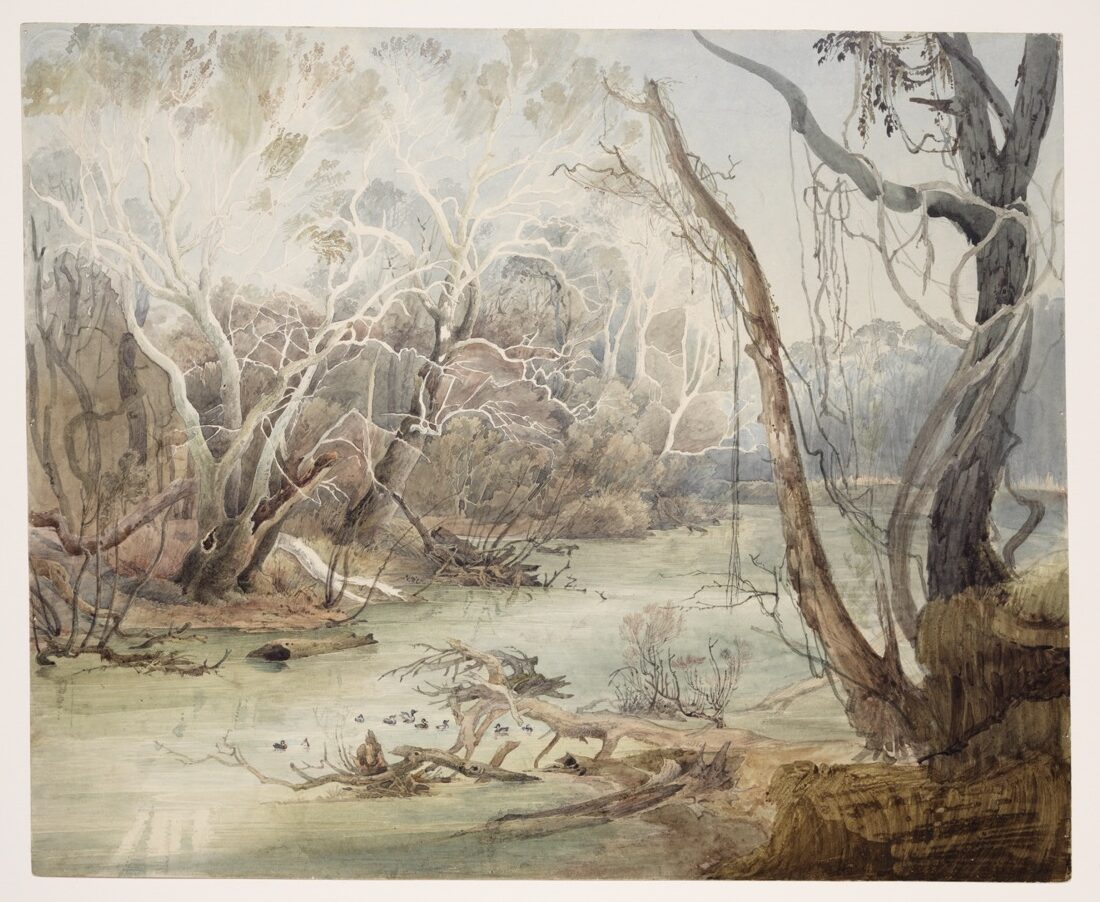
Walk with Mr. Say in the direction of the prairies at two o’clock. At the entrance to the forest, we found a pretty little nest of the red-eyed flycatcher, Wils. We saw several small birds, especially fringilla hundsonia and Fringilla canadensis as well as the small winter wren, the nuthatch, and other titmice creeping around on the fallen trunks. Several woodpeckers. We returned along the sandy bank of the Wabash, where we found many mussels, some of which are very interesting. The river was [at this time] very low. In the sand, one could see the tracks of raccoon and mink. At the crossing, two flatboats were being built: the bottom made from white oak or red oak, the sides from poplar (Liriodendron in this region). Then these boats are rolled over on twigs until they are afloat, but now and then they break apart while this work is being done. Boats like these go down to New Orleans. Mr. Bodmer returned at dusk. He brought a hunting dog that he had bought. He had seen the Mergus cucullatus  close by, as well as parakeets, but had not shot anything. He had made a sketch.
Today Mr. Lesueur was sick; he had a fever. At the same time, like Dreidoppel, he was suffering from an injury to his shinbones, which were soon very inflamed. For such wounds there is a good plaster here: the bark of slippery alum, or slippery elm (Ulmus rubra, red elm). When chewed or soaked in water, especially warm water, this bark swells and becomes so slimy that a viscous mucus is obtained. It is very cooling and refreshing and thus relieves the inflammation and keeps the wound smooth and moist. It also has a cooling and alleviating effect for diarrhea and in this case is both drunk and used as an enema, just as flaxseeds are, which also produce excellent results for us from the slimy liquid produced by boiling.
There are several additional, similar plants here that are used as home remedies, such as an African plant [— —] called Benin-plant, the leaves of which, when soaked in water, soon produce a mucous substance with which, especially, children are cured when they have diarrhea in the summer. Another plant is a species of Mentha (which, I believe, has a very aromatic, pleasant taste, almost like peppermint). Here and along the Mississippi, especially in the summer, one soaks [Mentha] in water with some sugar. It produces a cooling, pleasant, stomach-fortifying beverage. For the very frequently occurring cases of diarrhea here, some doctors prescribe enemas of flaxseed boiled in water, some cornstarch boiled, and a grain of opium. Most of the unskilled country doctors here, however, know nothing about these remedies and rely on calomel and castor oil. Afterward they give the patient rhubarb to aid recovery. Calomel must usually be taken several days in succession. The local doctors maintain that, in the eastern provinces of the Union beyond the Alleghenies, one can more readily do without calomel than in the western ones. Here it is absolutely necessary, and even German doctors, who initially had been completely opposed to this remedy, later recognized its great usefulness.
Today Mr. Bodmer had made a beautiful sketch of the Fox River in a true wilderness area, and wild ducks, especially Anas sponsa and Mergus cucullatus, had landed close to him while he was sketching. There were numerous gray squirrels in those woods, as well as one partly black one.
A letter that arrived today from New Orleans provided the saddest news about the devastations of cholera in that city and the environs. The inhabitants fled in all directions, the stores were closed, and all business came to a halt. Especially among the lower classes and the Negroes, the devastation is said to be frightful. Under such circumstances, we deeply regretted that we could not visit those interesting regions. Besides, it is very advantageous for us here in this region that the Wabash is now so low that steamboats cannot navigate it; thereby we remain more isolated from communication with the Mississippi. In Cincinnati and Louisville, health conditions have greatly improved.