November 8, 1833
In the morning, freezing; hoarfrost. We left the place early, and Charbonneau accompanied us. After we had traveled four miles we [landed] at a place on the right riverbank called la Fontaine Rouge [Red Spring]. Charbonneau wanted to show me a petrified tree stump there that was supposed to weigh perhaps several tons. We went through small parts of the forest and strips of prairie overgrown with high, dry plants up to the hills close by, where the so-called Fontaine Rouge, a spring streaming from the ground, was now swampy and covered with ice. Not far from there we found the trunk, which is considered to be part of an old cedar (Juniperus virginiana). It is the lower part of a trunk, where the roots begin, and entirely hollow; part of the root system [remains] connected to [the trunk].  The mass still shows the complete structure of the wood, but petrified. I took along a sufficient [number] of fragments lying around without disturbing the interesting trunk itself. Perhaps these pieces will appear in the future in a museum or [some] hodgepodge collection in the United States.
After we had breakfast, we sailed on; [it was] eleven fifteen. We reached the place where Mr. Pilcher formerly had a fort. It is about eleven miles from there to Fort Clark. After twelve fifteen we were opposite the first Hidatsa village. Opposite, two Indians were lying on the bank shouting to Mr. Charbonneau. Soon two more Indians showed with brown and white short-and-smooth-haired dogs with long, hanging ears. A few hundred paces farther [on] in the forest is the place where the Hidatsas spend the winter. Again there were Indians on the bank, among them one with a blue-and-white-striped Spanish blanket.
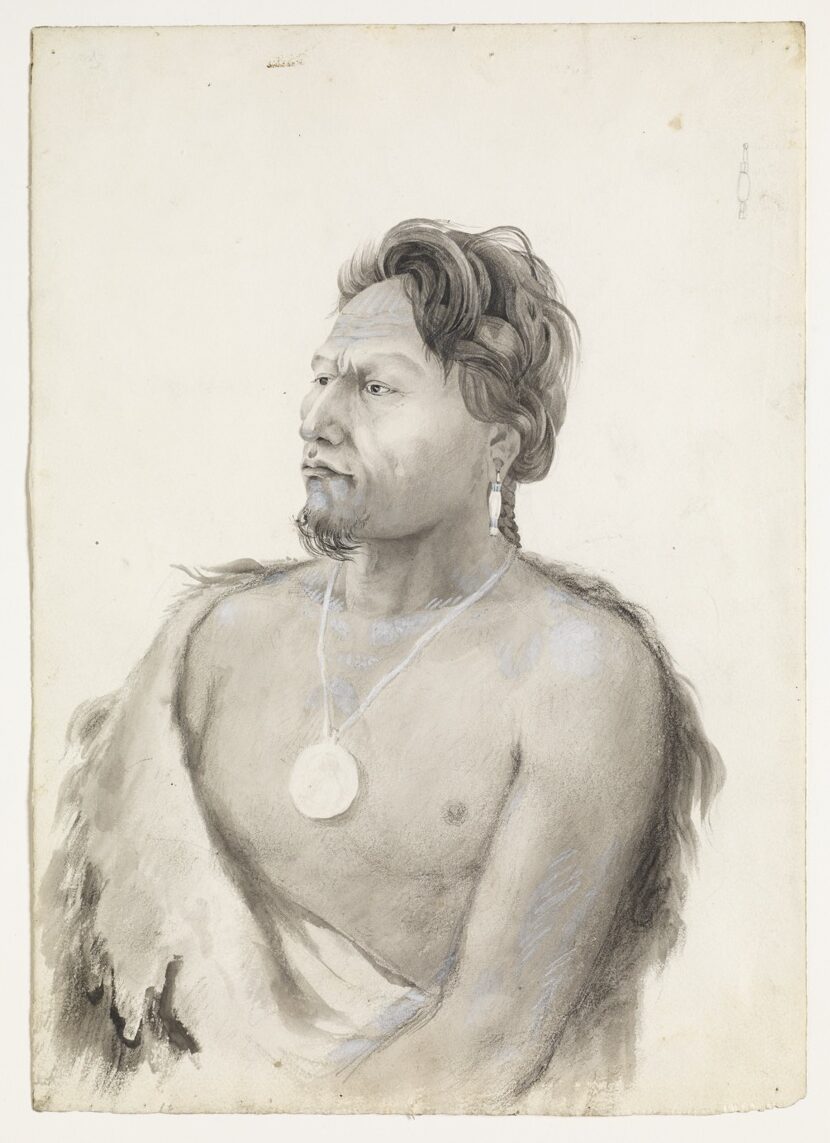
 At twelve thirty we were invited by the Indians to come ashore. Charbonneau advised us to [go]. A respected man, Íta-Widáhki-Hischä́ (le Garde Flèche Rouge), led us to his leather [tipi] that he had set up on a path to the forest on the prairie above the riverbank. The lodge was white, new, spacious, kept very warm, [and] very nicely decorated with colorful hair braids [locks] and porcupine [quilled] rosettes. At each side of the door was a long, bright strip made of porcupine quills and glass beads (see ‘a’ in drawing). The brother and the uncle of the host, [as well as] young men, children, and women, were in the lodge.
 The host wore a beard that extended a little below his chin, like [that of] the Ponca chief Schudegácheh (see the illustrations by Mr. Bodmer).
[Íta-Widáhki-Hischä́] had blackish blue stripes tattooed on his right breast. The old uncle had a very ugly face [and was] fat, with a drooping chest and thick belly. His clothes were disheveled [and] his genitals bare. The woman of the house had a child on her lap with a big harelip. We received corn and beans, very well done, in a large bowl, and the three of us ate out of the bowl with spoons [made] from [horns of] buffalo and bighorn. Then the pipe was circulated. We talked to them through Charbonneau. Our (crew) received a kettle with boiled corn, too, for which we gave a present of tobacco and some (gun)powder.
 At one o’clock we departed. To the right we saw the Hidatsa village next to the bank. [Neither of] the other villages can be seen from the river. The visible one is called Awacháhwi (le Village des Souliers) and contains eighteen lodges, or seventeen. It is situated near the Missouri. [At that moment] a few women crossed the river in a leather canoe [bullboat]; they have wood tied on[to it].
 These boats will be described later in detail. In the [tipi] just described, one of the women had a beautiful jacket, very broadly embroidered with blue and white [glass] pearls, [and] stars with centers of red cloth on the shoulders. A bit farther downriver, we saw the scaffolds of the Village des Souliers. At one thirty we traveled past the village. The sun was shining warmly now; we were sheltered [from the wind].
 After three-quarters of an hour with rather favorable wind, we saw Indian women with their round buffalo canoes to the right and left. Some wanted to cross; others were already across. They carried the boats away on their heads or their backs. Thirty-five to thirty-six years ago, a fort of the North Company stood there. To the right on the bank, an isolated wooden fort was built by the Indians. A crowd of Indians came to the bank, old and young ones; they looked somewhat dirty. At two thirty we reached Ruhptare, the first Mandan village to the right, where part of the stockades have large gaps. In various places Indians were sitting on the bank.
Charbonneau turned around so they would not recognize and call to him. He has five Hidatsa names: 1. le Cheffre du Petit Village; 2. l’Homme qui a Bien des Citrouilles; 3. le Grand Cheval de Loin; 4. l’Ours des Bois; 5. [this name] is vulgar and not to be mentioned here. Vulgar names are very common and favored among these Indians.
The area has a sterile look; to the left are barren prairies and prairie hills. Most of the black coal layers in the bluffs along the Missouri mentioned up to now are of no value. Some have a very strong smell of sulfur and do not offer adequate heat. They have been tried but found unusable by blacksmiths. Above the last Mandan village there is, however, an immense ten-foot layer of coal that burns well because it was never touched by water. This material always smells of sulfur. If it is to be used, it has to be dried out properly first. When we turned to the right around the promontory, we saw in the distance Mih-Tutta-Hangkusch, the second, or actually the first, Mandan village. And soon Fort Clark became visible too. The left bank was white, covered with salt, which occurs along the whole upper Missouri. Sometimes it is used in place of table salt when that is lacking; however, it purges [one] to a small degree. After we conquered the headwind, we ran aground in front of the Mandan village. But the stop did not last long. Some of the residents, who had mostly moved already to the forest, were sitting on the bank, which is high and steep here. [A few] were half naked in the cold wind, wrapped only in their robes.
We had just 300 to 400 paces to [go to reach] Fort Clark. However, [we] could not approach land right away but had to sail past and then return. Mr. Kipp welcomed us at about three or four o’clock at the bank and led us up to the fort. He is the clerk of the American Fur Company and also administers Fort Clark.
Fort Clark had not undergone any important changes during the time of our absence from [the place]. At the time [of our earlier visit] the Yanktonais wanted to make peace with the Mandans and Hidatsas, which did not materialize. At the beginning of September, the Yanktonais had finally achieved their ultimate purpose. Two hundred tents of Yanktonais had camped on the prairie behind Fort Creek and stayed there three to four days. They had many festivities and dances, and Fort Creek was crowded all day long with Dacota, Mandan, and Hidatsa Indians. Now it was quiet in the fort’s surroundings. Some Indians had already moved into their winter quarters in the neighboring forest. But many still maintained to besiege Mr. Kipp’s room every day. In the fort itself, there were two interpreters ([one of them,] Belhumeur, was an Ojibwe) for the Mandan language. By the way, Mr. Kipp was more fluent in speaking the Mandan language than Belhumeur. The other one was Ortubise, an interpreter of the Dacotalanguage. [Aside from] the interpreters, there were only six more men.
Mr. McKenzie had departed four days ago for Fort Union. He left many letters for me, among them, three from Germany written in December, January, February, and May. He had left orders to complete a recently started house in the fort for us to live in. But there was a lack of workers, meaning craftsmen. The fort’s store was well stocked [with] merchandise having a value of $15,000 in St. Louis, but with such a large number of rats here, all supplies were in danger. There is always a large quantity of corn on hand, often 600 to 800 bushels. However, it can be assumed that, at the time of our presence, these rodents were eating five bushels of this grain daily. The news I received from all places, except for a few, was generally good.Ortubise was absent; they expected him back daily with news from the lower Missouri.
Mr. McKenzie had taken a physician upriver with [him], because they were generally afraid of the cholera that had caused great devastation on the lower Missouri this past August. At Bellevue and Mr. Cabanné’s’s post, most people had died. Major Dougherty was almost the sole survivor of this frightful illness. We had the prospect of receiving new letters from Europe [soon]. Because the new house could not be finished quickly enough, all of us lived in Mr. Kipp’s small room, where he, too, slept, with [his] wife and child. As I mentioned, that [room] was always besieged by Indians. They sat down wherever they could find a place without further ado, amoked, and frequently received food. Mr. Kipp’s wife is a Mandan [with] nice facial features and rather white skin, showing even red cheeks. He has already been here eleven years without having been once in the United States. He therefore fluently speaks the language of the Sipuska-Númangkake (Mandans) and knows perfectly all their manners and customs. This day was clear, as [was] the night, but [it was] very raw, with strong wind.