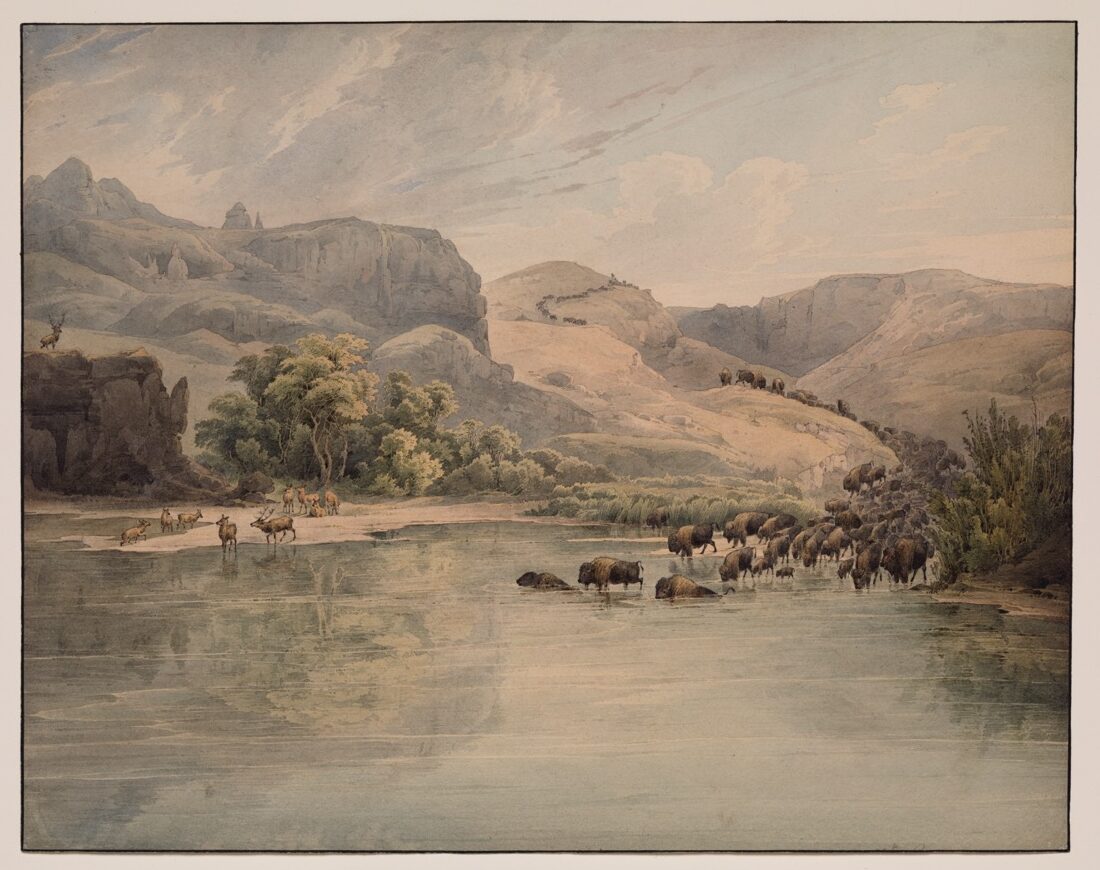
September 18, 1833
Everything around us was wet. We left [our] night quarters early. Today, as they had last evening, buffalo were moving on both banks along Dauphin Rapid in several herds. To the left under the high, steep mountains of the Mauvaises-Terres [Badlands], we saw bulls everywhere in small bunches or alone and in the river; we tried to get closer (only to the cows), but today the wind blew downriver all day from behind us and [thus] was always unfavorable for our hunting efforts. We saw the current was so strong that we quickly caught up with the animals. Well within whitish gray bighorn standing near the mountains, and before us a troop of twelve elk with a big bull trotted through the river. They looked very fine in their mating color, the bull especially: their bodies were light in color, pale whitish yellowish reddish; neck, belly, and four legs blackish brown, black in the case of the bull.
Somewhat farther downstream in the river valley, surrounded by high, steep, whitish gray clay mountains, we got out to cautiously approach a large buffalo herd, but here, too, the unfavorable wind drove away the game. The animals galloped downstream along the river, in the prairie overgrown with sage and thorns, and then turned into a small lateral valley. We pursued them [there] for a while, but the entire herd climbed up a steep mountain to the highest precipices; with astonishment we saw how [these] heavy animals reached [such a] height. But they climbed too high, (and) suddenly all of them ran down again, without, however, our having a chance to shoot.
I described the mountains of the Mauvaises-Terres [Badlands] in the journey upstream. Now, too, we could not sufficiently admire their singularity. In several places they had brick-red domes, patches, and stripes, where the red clay appears as perfectly baked as in a brick kiln. At the foot of the mountains the sage (Artemisia [——]) and the light-green thorn covered all the level areas or prairies.
At 9:30 we went ashore on the left bank and (with a very raw, cold wind) started a big fire and prepared our breakfast of coffee and bighorn meat, the remainder of which we saved for a cold lunch. The sky was overcast, and the sun could not shine through. At eleven o’clock we left this place where, in the pines (épinettes) along the mountains, the small tree frogs were still chirring vigorously. Soon we were aground; the crew got into the water and pushed the boat. Then we passed rapids and soon reached the place where Bodmer and Papin had gone out shooting bighorn when we were moving upstream. At that time (2 August) we had found petrified cedar on the bank.
At 12:30 we reached the region where Mr. Mitchell [had] lost his fine powder horn. We wanted to stop in this region to make a drawing of the Mauvaises-Terres [Badlands], but the many buffalo herds found here and a gunshot, which we heard to the right in the mountains, led us to assume the approach of Indians. We therefore decided to abandon our plan and to continue on. Somewhat farther downstream among the high hills, a lateral valley opened up; several herds of buffalo were grazing there. To the right on shore, six huge bulls, which we could easily have shot, galloped beside us. They crossed the river and joined another troop, so that there were twenty-seven bulls together, all of which galloped downstream along the bank beside us. Four of them ran into a side ravine, where, however, they soon had to turn around again. Somewhat farther [on,] the river turned to the right; the buffalo had to descend here, one by one, below a steep wall along the river. We sailed down through a narrow channel between two sandbars, and rifle range, they filed along beside us; they were apprehensive about this, but we did not want to shoot. To the right, [more] buffalo were standing in a cottonwood forest. Yesterday, following the rain, the river had lost its light-green color and clarity.
At two o’clock the mouth of Wirry Wincher’s [Windsor’s] Creek lay to our left, above which was a big buffalo herd. Several bulls stood to the right, caught wind of us, [and] crossed the river, and [then] the entire herd fled toward the steep, strange mountains overgrown with individual pines. To the right on the bank, a wolf. On the green promontory opposite a small island, another buffalo herd was grazing. To the right on the sandbar again, a wolf, gray-yellowish, blackish on its back. A quarter of an hour farther [on], around a bend of the river, another wolf walked to the right; somewhat farther [on,] a herd of buffalo let us approach close to them, since we had a good wind. Scarcely a quarter of an hour [later], a herd of at least 150 buffalo crowded together moved into the river to drink. The view was most interesting: cows, calves, and bulls were mingled; the latter were bellowing mightily and drove the cows. We sat motionless, let the boat drift, and came within favorable rifle range, apparently without their noticing us. Scarcely 60 paces farther [along], [we saw] a troop of six cow elk on a sandbar near a small willow island; [they were] with a powerful bull, which emitted a bugling cry and three times covered a cow 300 paces directly in front of us. A good bull, which had been driven off [and] stood 100 paces farther away on the high bank of the prairie, got wind of us, and all of them, elk and buffalo, took flight. We should have gotten out earlier. [We] did not want to shoot at the buffalo, in order to observe the bull elk very closely. Somewhat farther away, on a small island, we again found buffalo, which got wind of us, something that spoiled everything for us the whole day. Today we had seen more than several thousand buffalo and many elk and bighorn, and also antelope; the journey this chapter describes certainly [was] unique for a hunting enthusiast.
Soon again, buffalo on the right and left bank; five elk in flight on the prairie. Morrin got out but arrived too late; the game had reached the ravines on the side. Our tame bears greatly disturbed us today with their growling and strange plaintive cries. Before us lay a beautiful landscape; to the right, in the prairie before the mountains, a herd of buffalo, which were bellowing; five elk ran before us toward an elk island in the river; the buffalo bellowed in a grating and wheezing manner and drove the cows about. The elk splashed in the water such that one could hear the noise from a distance. We put Dreidoppel and Morrin ashore in the narrow channel of the elk island on which we had shot so much game on the way up. They were to shoot game. The rest of us navigated up to the tip of the island, where we landed and started a cooking fire.
A white wolf observed us from the steep left bank, and a large heron (Ardea herodias) steered away from the old cottonwoods of the island. Dreidoppel found the elk and saw numerous buffalo on the island. He fired his bullet into the trunk of a cottonwood tree. Morrin was luckier; near our fire he shot one of three whitetailed does, which we immediately cut up and cooked. I combed a part of the island, found rutting grounds of deer and buffalo in the tall grass, [and] heard the bugling sound of bull elk and the bawling of the buffalo. But evening soon fell, and in the twilight of the tall dark forest, the great horned owl began its “Hoo! Hoo! Hoo!” I saw it perched on a branch close to me. Sage and other plants covered the open areas in the forest.
While our kettles were boiling, night descended. We agreed to take along the half-cooked meat and leave our campfire area because of the Indians. We continued to sail until nine o’clock at night. The moon shone brightly; weather and river were very beautiful. Buffalo herds trotted, splashing through the river; bull elk bugled to the right and left in the woodlands; wolves howled at various places in a remarkable chorus; and the great horned owl was heard in many places (it is very numerous on the upper Missouri). My watch duty lasted until eleven o’clock, when I woke Mr. Bodmer, who relieved me. We were terribly cold in our beds; the woolen blankets, which had been drenched by the rain the previous night, were frozen solid in the morning.