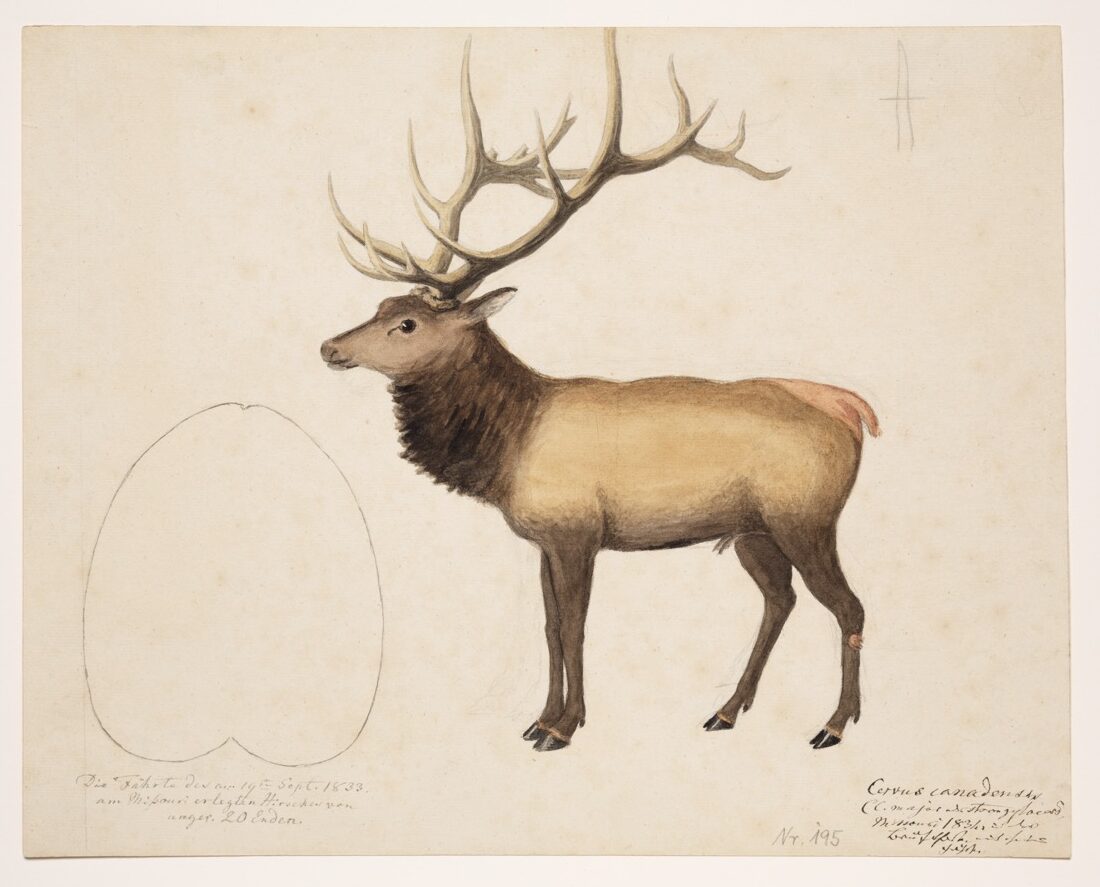
September 19, 1833
It was very cold early in the morning; fog was rising from the river. We set out in the morning twilight and were numb with cold. Soon, when it was light, we saw elk in large numbers. Five head went through the river; a big bull followed; he bugled before us in the water. Our rifles were ready to fire when, on the right-hand side in the tall cottonwood forest on the steep, 20-foot-high bank, an even larger bull bugled. The game came to within 40 paces, and because the bank was too steep for them, they moved upstream beside it, close past us. The bull turned around, remained standing near the river, and bugled. Meanwhile, the big bull on the right bank had gone completely onto the shore and stood there very majestically, bugling incessantly. Morrin, who was ready first, dropped him. Dreidoppel shot a two-yearold cow in the river; it immediately perished and was carried away by the current. Mr. Bodmer fired at the bull on the other side, but it was out of range.
We quickly landed and climbed the bank, where we found an indescribably magnificent animal. The bull was very old and large; his huge antlers had thick, tall prongs, long points, and carried, to use German hunter’s jargon, an uneven 20 of them. The weight of both branches, sawed off at the base, was 24 pounds. The bull was 7 feet [——] inches [——] lines long. The beautiful pale yellowish color of its body was very nicely accentuated by the black-brown color on its neck, belly, and four legs. Because this bull was so outstandingly impressive and large, I decided to add it to my zoological collection, and we immediately set to work removing the hide. Beforehand, I measured the impressive animal and described it in my [Natural History] Diary. Because some of our baggage, especially the bedding, was still wet, we also used this halt to spread it out on bushes in a sparse area in the forest for drying; the weather today was very favorable for this purpose. The day became very pleasant and hot; there was also a breeze favorable for drying. Our fire soon flared up among the young cottonwood trees, and after the splendid hunt, our breakfast was eaten in high spirits. We saw buffalo moving on the opposite riverbank, but the bull elk had fallen silent after our four shots. Until two o’clock we stayed at this place. By then our bedding was dry and the elk hide somewhat cleaned; it was packed up, and we left this place.
Soon, around the bend of the river, we found the two-year-old doe [that] Dreidoppel had shot hanging in the driftwood on the left bank, but we did not halt because of it; the current quickly swept us past. Buffalo were grazing near the mountain. Fulica americana (coots) were here in considerable numbers, as [were] magpies; 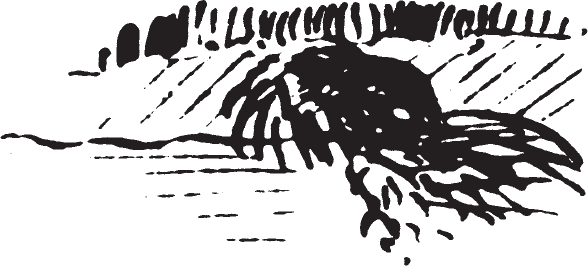 to the left on the flat willow bank, we saw a beaver lodge and many beaver paths, or slides, running down to the water. Down in the water, before the heap of twigs that forms the actual den of the beaver, there was a large bundle of green cottonwood and willow branches; [they] serve as food for the beaver.
We [then] reached the series of small, narrow islands in the river that we had rapidly passed sailing upstream with a good wind on 31 July. Here dark clouds appeared as heralds of a thunderstorm, and we therefore tied up for a short time in the shelter of a narrow island covered with a cottonwood forest. Individual buffalo appeared everywhere, one of which Mr. Bodmer wounded but which we did not pursue. The island was joined to the left bank by a dried-up channel. At 4:23 the bull elk in the tall forest of the left bank began to scream, or rather to bugle and whistle; we also saw two white-tailed does on the left bank.
After five o’clock we reached the prairie where we had killed the prairie dogs on 31 July. [We] did not halt, however, but sped our journey toward the wooded promontory on which we had fastened the large bear to a tree. With great hopes, we went ashore in that forest and hoped to find a specimen of great interest, now completely freed of the remnants of flesh—but what a disappointment! There was nothing more to be found of the magnificent bear skeleton, except several crunched and scattered bones. The bare, fork-shaped tree stump, into which we had hoisted and fastened the bear with a rope, had been clawed all around by bears; and we saw [that] they were the ones that had inflicted this painful loss upon us. The rope still hung fast to the tree. We searched through the tall plants [where] the bears had trampled down large areas and destroyed our treasure; the skull was not to be found anywhere.
Regretfully we left this place and continued our journey rapidly down the river. The evening was pleasant; everywhere we saw buffalo bulls on the bank in twos and threes. Bull elk bugled in the woodlands but not as frequently as yesterday. We saw several wolves. In the evening bats flew over the surface of the river in swarms. Eagles and falcons appeared frequently among the tall trees of the bank. When dusk fell, we sailed quietly and cautiously; the lonely, densely wooded banks of this remote wilderness lay silent before us. On the left bank, we saw the canoe in which Doucette and his companions had come to our keelboat on 30 July; it had been left lying there. We continued the journey by moonlight, but the dark shadows cast [by] the tall, wooded banks were dangerous for us, for here the water rushed and raged past many partly visible, partly hidden snags, or chicots, which we [could] steer clear of only with great caution; fortunately our steersman, Morrin, understood these matters very well.
At nine o’clock we landed at a large, flat sandbar off the right bank; [we] landed quietly, and only our bears could have betrayed us with their roars, complaints, and scratching on the crate. During the second part of a watch, about two o’clock, magnificent northern lights. Ten to twelve perpendicular columns of light radiated parallel to and separate from one another, often on the horizon, often higher above it. The [lights] often changed, but after [only] half an hour, their beauty vanished, [although] the sky and horizon in this region remained light. Buffalo trotted through the river; the great horned owl called out. Toward morning it became very cold, and hoarfrost covered us.