Journey from Cantonment Leavenworth to the Grand Bend and the Little Missouri
Dangerous place – Wåssóbä-Wakándagä – Independence Creek – Blacksnake Hills with trading house – Nodaway River – Wolf River – Grand Nemaha River – Land of the Half-breeds – Nishnabotna River – Little Nemaha River – Violent storm – Weeping Water Creek – Platte River – Bellevue – Omaha Indians – Their dance – Council Bluff – Boyer Creek – Little Sioux River – Blackbird Hill – Floyd’s Grave and River – Big Sioux River – Iowa River – Vermillion River – Jacques River – The Ponca Indians – Meeting with the steamboat Assiniboine – Striking hills – Cedar Island – Long halt because of lack of water – First view of bison and antelope – Long stay near the Bijou Hills – Cedar Fort – Sioux Agency – The Dacota (Sioux) Indians – Big Bend – Medicine River – Teton River – Fort
May 4, 1833
In the morning, bright and only slightly cloudy sky, pleasant. Late yesterday evening it was just as beautiful, and the moon shone so clearly that we sat past nine o’ clock on the afterdeck of the ship. Calm prevailed over the entire landscape; only the whippoorwill called out in the forest. The moon was reflected splendidly on the smooth surface of the river, where several young persons, including Bodmer, were bathing. This morning at 7:30 Later two storms gathered; there was thunder and lightning.
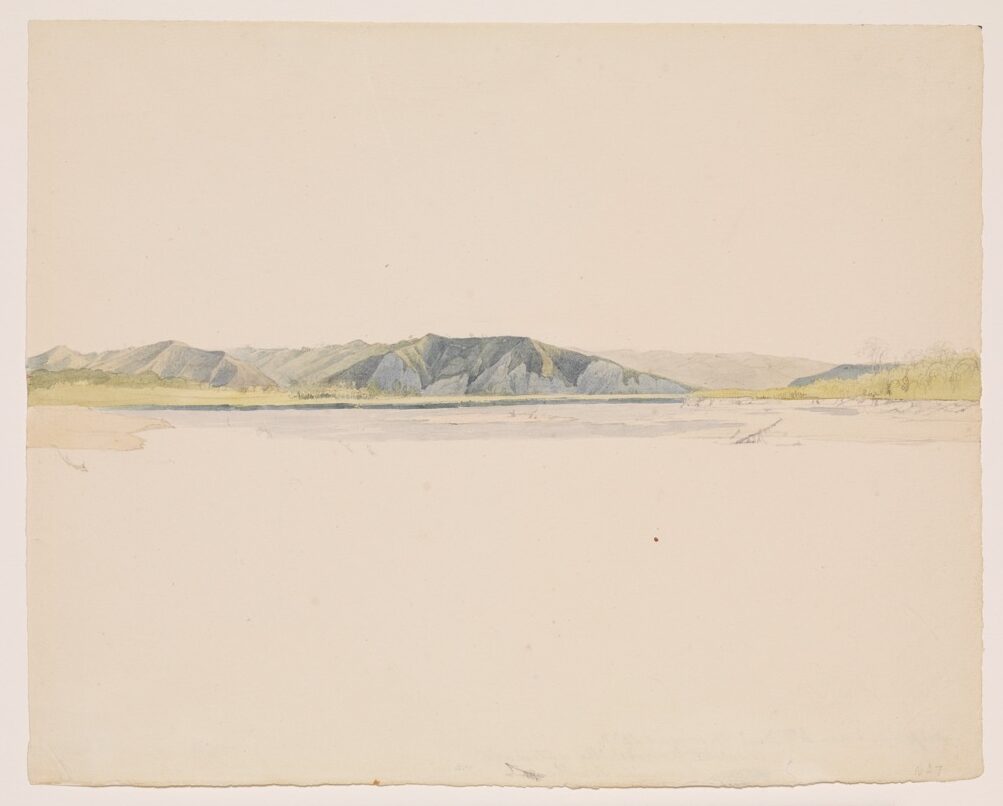
At 7:30 today, 69 3/4°F [21°C]. Beautiful, low prairie hills surrounded us, and before them [lay] flat alluvial land with a beautiful growth of grass. The river has risen an inch. On the extensive sandbars is much driftwood; wild geese flee before the steaming monster. Close before us we now have a chain of picturesque hills, Ard’s Hills, also (perhaps incorrectly) called Hards Hills. They have striking edges and singularly formed tops and ridges. Here was once a trading house, which has closed down. Mr. Bodmer made a sketch of the hills. The river makes a big bend here.
 Next came a very low-lying spot in the river, where the ship violently struck bottom. The boat made soundings, and [we] found a deeper channel. To the right, washed-up soil with willows and cottonwoods. Large trunks make up the foundation of these alluvia; some of them project 4 to 5 feet from the steep bank. The river turns left; the promontory to the left is sand with a large deposit of wood. The river passes not far from the hill chain, which remains to the right, but now we are leaving it. Little water in the river; we strike a sandbar. Wild geese swim and fly around us. To the left we put in at a sandbar or sandy island and cut the driftwood lying here into split logs and firewood. At the tip of the island, we found the nest of a wild goose (Anser canadensis) with four incubated eggs. Once again, [a] singular view of Ard Hills (see the sketch). Because we had little water, we turned back again after an hour and made a short detour. Part of the cargo had already been moved into the mackinaw boats. Presently we found more water. On both banks there was low-lying alluvial land with banks about 8 to 10 feet high; to the right it was overgrown with willow and cottonwood. To the left, six to eight pairs of wood ducks flew up.
We sailed again toward the hill chain on the left bank; some of it was colored green, some blackish violet. Before we got there, we were shown a site on the green prairie ridge where an Iowa village once stood. The chief died and his people moved down to their tribal relatives. To the left along the bank, one saw whole stretches of black, dead cottonwoods; the Indians set fire to the prairie and in this way also burn the trees. The dark spots of the hills were also burned forest. Roy Creek, which is quite small, empties to the left; large deposits of driftwood [lay] chaotically tangled near the riverbank. The burned forest had tall, completely black trees; here and there individual trees were a most beautiful green.
At a small bend of the river to the left, we found tall yellow bluffs in the forest. Somewhat farther ahead appear the white buildings of Mr. Cabanné’s trading house. Mr. Cabanné is a partner in the Fur Company, no longer young, and wants to leave here in about two weeks to retire in St. Louis. He is a relative of Mr. Chouteau’s. In the future, Mr. Pilcher will take his place. Upon our approach the cannon was fired several times. Thousands of swallows were nesting in the very high yellow bluffs to the left. In many places the soil from the hills has collapsed and slid down in great layers, with all its forest trees; it forms ledges and steps, a second, preliminary bank. These bluffs appear to be reddish yellow clay; under them are layers of grayish blue clay.
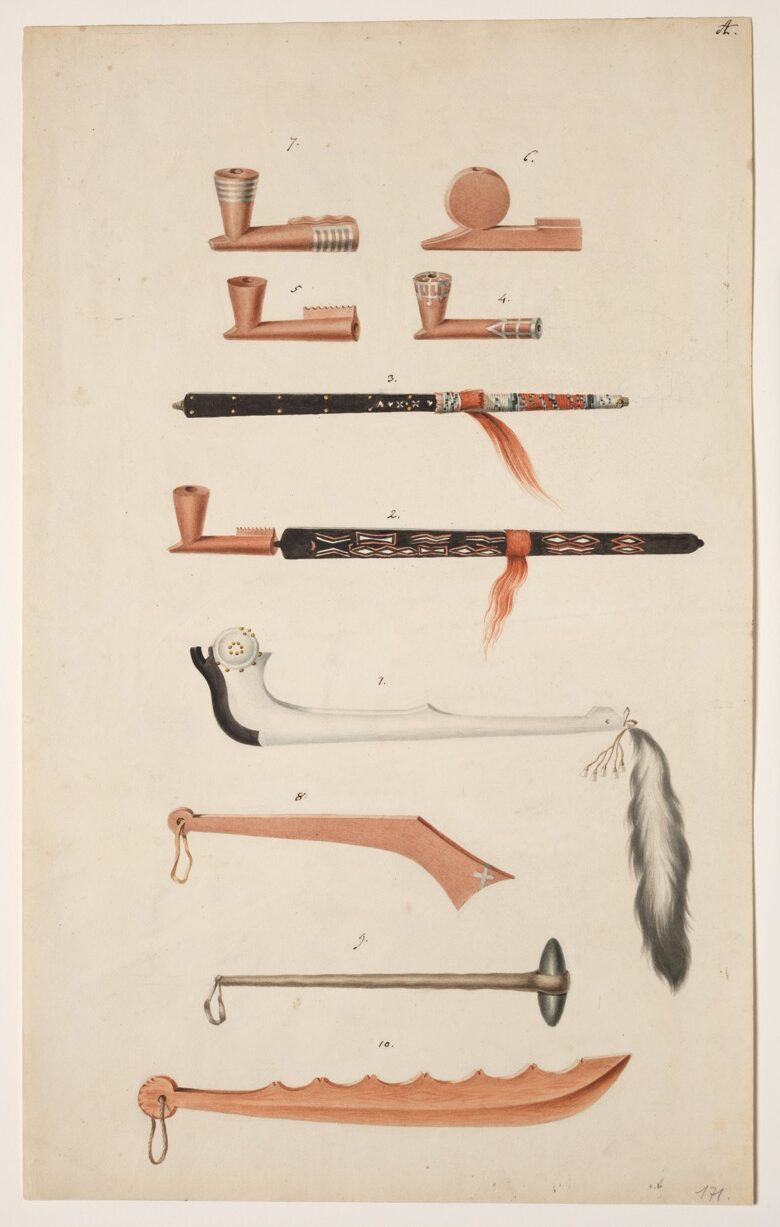
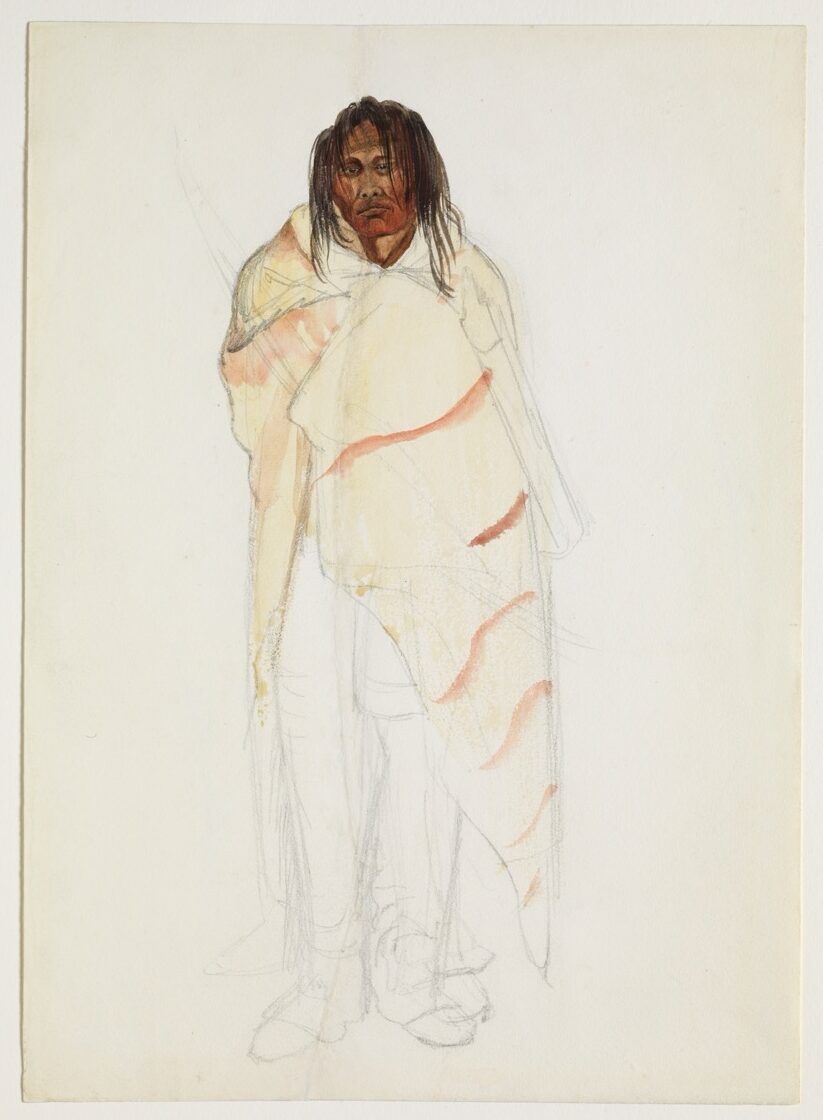
When we arrived we saw, to our delight, a crowd of Indians: Otoes, Omahas, and one Iowa who lives with the Otoes. Behind a bush sat an old man with whitish gray hair; [he was] wrapped in a bison skin. Most of the Indians had buffalo hides around their shoulders with the hair turned outward; some had blankets, mostly white, that they paint with colorful stripes. In their facial features, they did not differ especially from those we had seen earlier; they were not as handsome as the Sauks and Meskwakis. Many were scarred by smallpox, several with one eye—a patch on the other one—probably from smallpox. They had let their hair hang down to their necks in disorderly fashion; [it was] never shaved off. Some of their leggins were very nicely stitched. Their war clubs (see the illustration) were fitted on top with a round ball of white wood studded with yellow nails, with the skin of a very colorful skunk on the end of the handle. A bundle of teeth from slain enemies was attached. They had pierced their ears with several holes along the edge, in which they wore blue and white wampum [bead] strings.
 Their mouths and noses were not deformed. Their bows were about 3 feet long, made of white wood, simply and smoothly finished. The quiver is a simple leather bag in which the [— —]-inch-long arrows with three rows of feathers are kept. They are colorfully painted, the feathers stained; the head is made of iron; it is glued in. The women’s faces were not so smooth and flat as in the case of the Sauks and Meskwakis; their noses were longer.

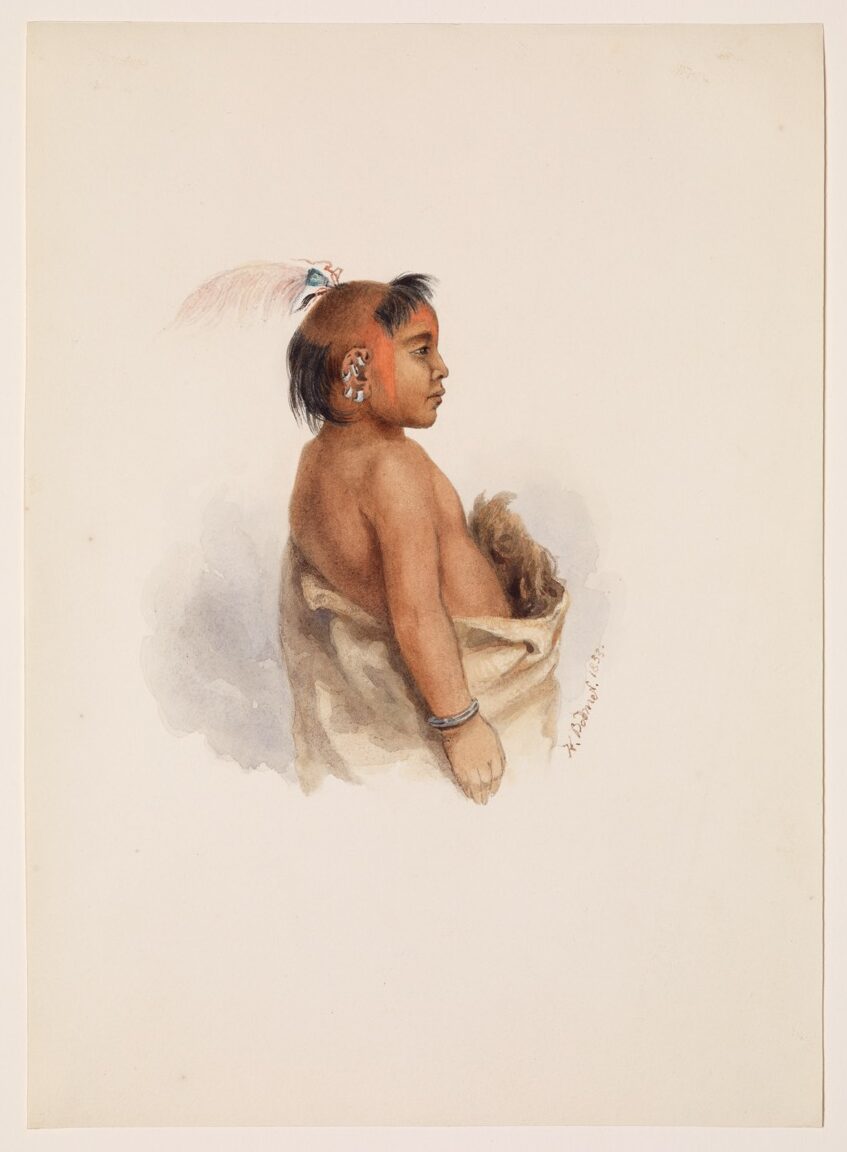
Mr. Bodmer sketched an Omaha, at least (5 feet) 10 1/2 to 11 inches tall, and his pretty child, whom the father had painted, since he was to be sketched. He had shaved [the boy’s] head and had left a tuft of hair in back and in front; in the middle of his head, a large white feather was fastened. From an Iowa (also [5 feet] 10 inches tall) living here with the Otoes, I bought a bow and arrows, a pair of beautifully decorated leggins, and an interesting whip made of elk bones, on which Indian figures are sketched, one of them with a scalp in his hand. The whip is studded with yellow nails. This man had an attractive, friendly face; he lives here near the Omahas, who recently made war on his people, but is not worried because they know that he does not live with his tribe.
All of them had black and red Sioux pipes decorated with tin or lead, which they did not want to give away cheaply. A child, recently wounded by the Iowas, with two wounds in its chest, was brought to the ship by its parents; it was naked under a wool blanket, and the wounds were almost completely uncovered and exposed to the air. Here one saw more old than young people and many women, several of whom are married to white men. A few wore white, others yellow armbands.
Mr. Cabanné had lunch with us. Later I called on him; his house, which also includes the store for Indian goods, had a nice view from a balcony, which affords a prospect of the river. He showed me the nearby cornfields, where fifteen acres produce two thousand bushels of corn every year; the fertility is said to be quite exceptional. Later, when the Indians were at the ship, I showed them a rattlesnake in whiskey, and they said that recently a child on the left riverbank had been bitten by one and had died.
A strong wind blew all day; the heat, however, was very great where there was no wind. At four o’clock, 78°F [25.6°C]. The ship stayed here today because all kinds of things had to be taken care of. The evening was most pleasant. On Mr. Cabanné’s balcony we enjoyed the magnificent evening. The majestic Missouri gleamed splendidly in the calm evening air; only the frogs were chirring, and the whippoorwill called incessantly until finally the full moon rose above the horizon. The Indians had left the ship, where it was exceptionally warm.