June 27, 1833
Beautiful, clear, warm weather; some wind. At nine o’clock, 62°F [16.7°C]. 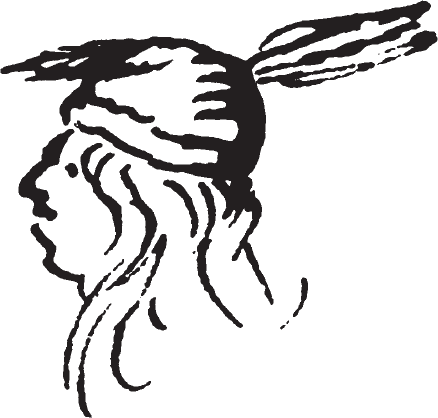 Individual Indians arrived early. About nine o’clock, ten men, some with interesting costumes. Some had skin caps, one of them with the entire tail of a prairie hen in front and several ornamented feathers in back. They were not Assiniboines but from the nation of the Crees, or Kristenaux. They had come from a distance of about four days [of travel]. Their outward appearance is not significantly different fromthat from that of the Assiniboines. They wore their hair
in front hanging naturally around their heads, often long, down to over the shoulders. In front they had a tuft (of hair) down over the nose and cut bluntly across; likewise on each side. Many wrapped their gun sheaths around their heads like leather caps. Faces painted red, some with black stripes. Clothing made of leather, ornamented, and with round rosettes of porcupine quills. They had quivers, bows, arrows, [and] guns; several had bows [with] lance and bow fastened together. Several were naked and had on only leather pants and buffalo hides. The chief, Maskepetoon, wore a medal. He had been to Washington with Sanford.
The Crees live in the same district as the Assiniboines, which is bounded by the Missouri and the Saskatchewan [rivers], as well as Lake Winnipeg. They show many similarities with the Assiniboines; [they] live in leather [tipis] and, like the [Assiniboines], do not have many horses. They need dogs for pack animals. They are poor and live very scattered about. They are estimated to be six to seven hundred [tipis] strong, and there are estimated to be three men to each [tipi], thus about 1,800 to 2,100 men in all. They came here now to see Mr. McKenzie. They did not bring hides, because this is not the season for them. They live entirely from hunting and, like the nearby nations, follow the bison. They make large parks where they kill many of these animals at a time.
Some of their guns were decorated with small strips of red cloth and studded with yellow nails; they carried their ramrods in their hands, and several had decorated their hide ammunition bags with colorful cloth. Several wore long wolfskins over their shoulders, with the head over the chest and the tail trailing on the ground. On their leggins, a large number of leather fringes, some of which drag on the ground. Because it was very warm today, many of the Indians had wound thick wreaths of green foliage around their heads. They looked much overheated and somewhat fatigued, and their vermilion-painted faces had suffered from the perspiration.
The language of the Crees is related to that of the Ojibwes but [is] completely different from that of the Assiniboines or the Dacota language. Some Crees understand Dacota; at Fort Union there was an interpreter, Halcro, for the Assiniboines and another, Lafontaine, for the Crees.
| Language Samples of the Crees (Kristenaux) | |
|---|---|
| WORDS | |
| Sun | Pisimm |
| Moon | Tepiskao-pisimm (‘o’ barely audible, “night sun”) |
| Star | Atsah-kossack (short, together) |
| God | Keseh-mann-tóh (second ‘e’ short) |
| Fire | Skuttehu (‘u’ barely audible) |
| Water | Nipí |
| Earth | Askí |
| Man | Hiyenú |
| Woman | Iskwä́u (‘ä́’ and ‘u’ separate, ‘u’ softly pronounced) |
| Child | Auáhsis (‘sis’ short and soft) |
| Head | Ustekuaan (‘Us’ very short) |
| Arm | Ospeton |
| Hand | Otsä-tschih |
| Hair | Uästöchaiah (somewhat indistinctly) |
| Eye | Oskíhsick |
| Mouth | Otoon |
| Bow | Adsabí (‘Adsa’ soft) |
| Arrow | Atuss |
| Pipe | Spoagánn (soft) |
| Tomahawk | Tschiga-hika-spoagánn |
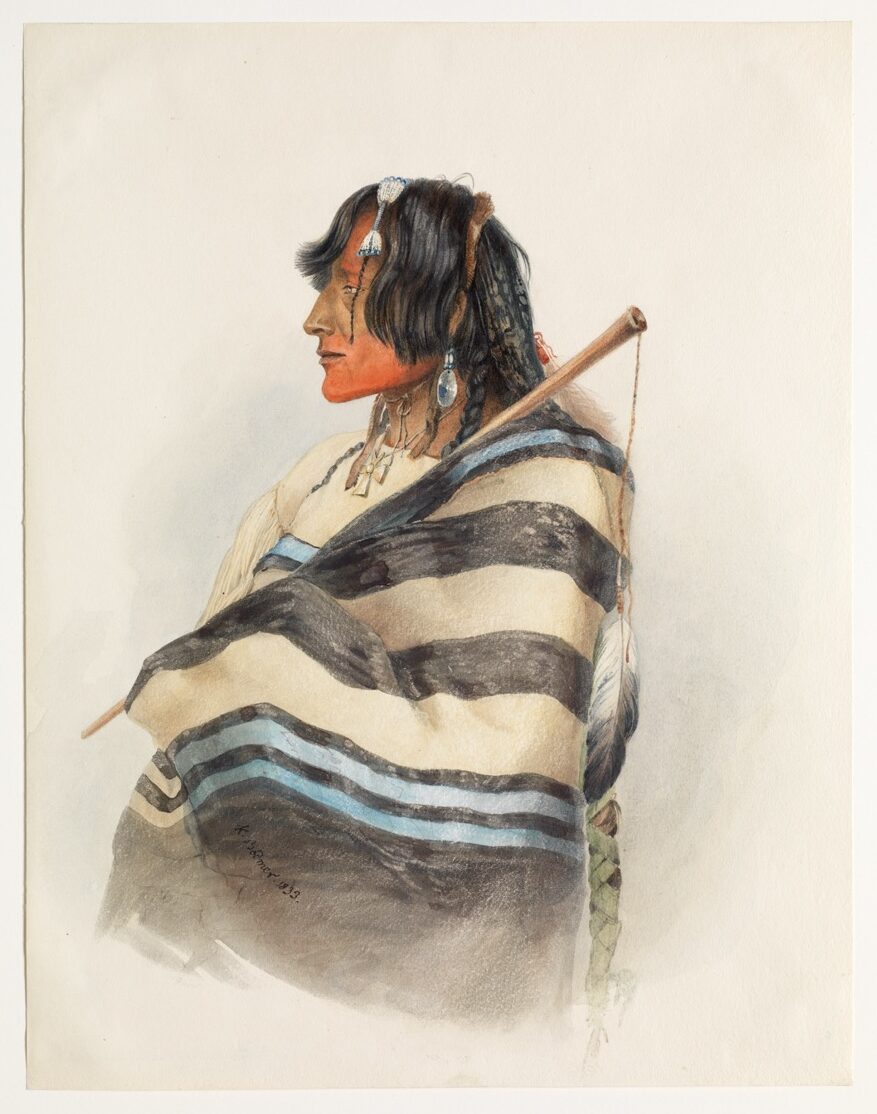
 Regardless of the noonday heat, the Indians still went about in their large buffalo hides; many had caps on their heads, several of [them] made from thick woolen blankets. A few had painted themselves red just around the eyes; others the entire face; and others with red stripes. Some wore bead ornaments at the side of their heads, like the Mandans and Hidatsas (also depicted in the picture of the Blackfoot Kiäsax).
We traded for various small items of theirs, and from Mr. McKenzie’s’ stock I obtained a fine Crow (Corbeaux) costume: shirt, leggins, moccasins. A trader who here clerk in Mr. McKenzies service presented me with an Arikara scalp. The man from whom this scalp was taken had murdered an old white man, a certain Glass; others had killed several more whites along the Yellowstone. They drove the Indians away and caught two of them, whom they tied up and forced to sit down. The one from whom the scalp came found a way to cut himself loose and tried to escape. In the dense willow thicket he ran into a white man, whom he tried to kill, but he himself was cut down with a knife. The other one, who also escaped, was shot dead. The scalp was taken as a souvenir and is now in my possession.
At noon it was very hot: 70°F [21.1°C] in the house. Early in the afternoon, we learned that the Assiniboines were approaching, and everybody ran in front of the fort to see them arriving. They wanted to greet Mr. McKenzie. This sight was indescribably interesting. Toward the northwest the entire prairie was covered with Indians and dogs pulling their baggage. At the head strode the armed men, or warriors, about 250 to 300, like several companies advancing side by side in a front. To a military man I can make the matter more explicit in few words. These warriors moved at a rapid pace and in rather closed formation. They did not hold rank, but nevertheless they were not more than three to four men deep and thus already formed an imposing front. Three to four chiefs went in front of the center, somewhat as the standard-bearers march in front of a Prussian battalion. Single, heavily charged shots rang out everywhere from the multitude. They all combined in singing their peculiar chant, which includes many individually interrupted tones, often repeated, similar to that of the Russians. Still in the distance, behind the multitude of the warriors, we saw the dogs, loaded with packs, covering the entire prairie. [The men] were accompanied by individual women and children or young people.
Thus this interesting throng pushed nearer and nearer, and the nearer they came, the more interesting were the features that unfolded. They were all wrapped in their buffalo hides but [also] decked out in manifold ways. Most of them had red faces; individual ones were completely black. Feathers from birds of prey on their heads, and on their feet, fox or wolf tails as marks of honor for slain enemies. Guns in their arms; on their backs, bows and arrows and leather or fur quivers and bow covers, fastened to each other. Some had large wolfskin caps on their heads, which certainly could not cool them off in the great heat. Several of these caps, as well as most of their articles of clothing, were colored half-red reddish with red dye. There were many tall men among them. I saw one who was certainly 6 feet tall; those measuring [feet] 8 to 9 inches [Prussian measure] were very numerous. Some had a frightening appearance; one may say that they looked martial to the highest degree, and their proud, erect bearing in rapid stride lent them a manly, military appearance. Many had green twigs around their heads; others, indeed, a large number of them, carried wings from birds of prey in their hands for fanning themselves. One saw very fine leather costumes: leather shirts with the most colorfully embroidered large rosettes on the chest and back, hair and fringes of leather on the shirts and leggins. Wild music resounded from the ranks of these savage, rough warriors; they were beating a kind of drum and rattled at the same time. In this way they advanced to about 60 paces [from] the fort, to a natural trench, extending upward from the river, and halted there. The chiefs stood in front. Both interpreters were sent out to meet them. Soon afterward they marched in.
The gate of the fort was closed, and a guard let in only as many persons as were permitted. The Indians immediately went to the river to drink, then stood or sat down in the shade. The chiefs and about thirty of the main warriors were admitted, and they seated themselves in the big room always intended for the Indians in the fort.  Here they sat down all around the walls, and their big, thick stone pipes were passed around.
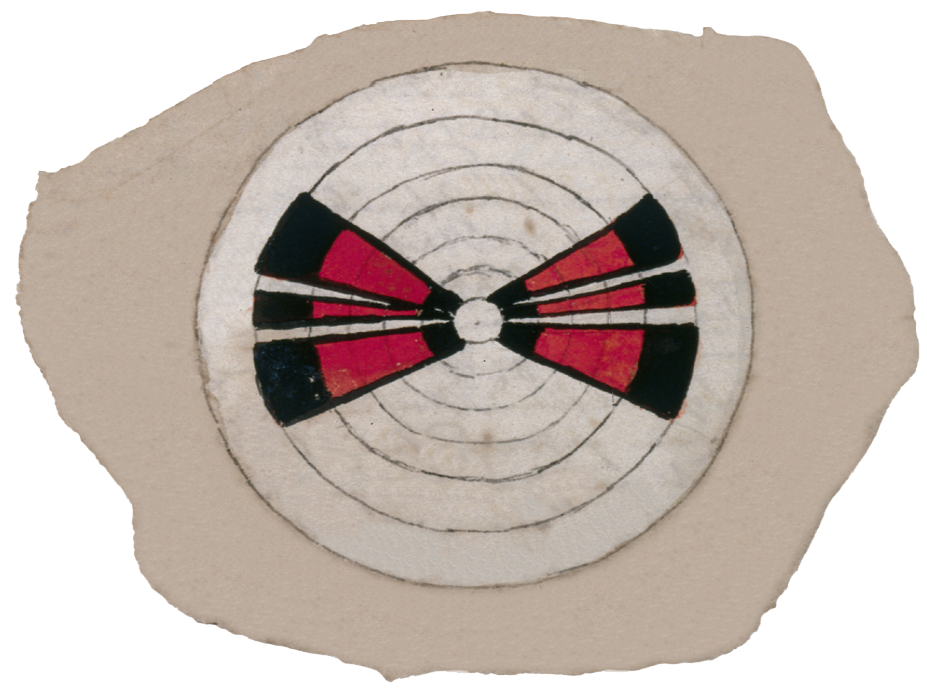 They also had with them another fine pipe stem, ornamented with yellow horsehair tufts and yellow nails, which they intended as a gift for Mr. McKenzie.
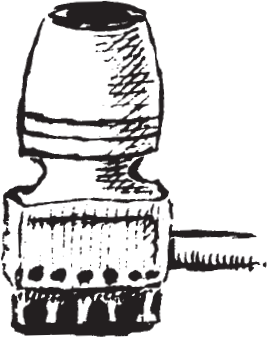 The scene here in this hall was most interesting. The warriors spoke little and enjoyed their pipes, the exquisite vapors of which they inhaled in deep drafts. A pail with diluted whiskey was brought in, from which the interpreter gave each of them a certain amount to drink. Before they drank, most of them sprinkled this whiskey five to six times in the air with the first fingers of the right hand, probably as an offering to the Great Spirit, Uakán-tang-e in their language. Then they smoked, one after the other.
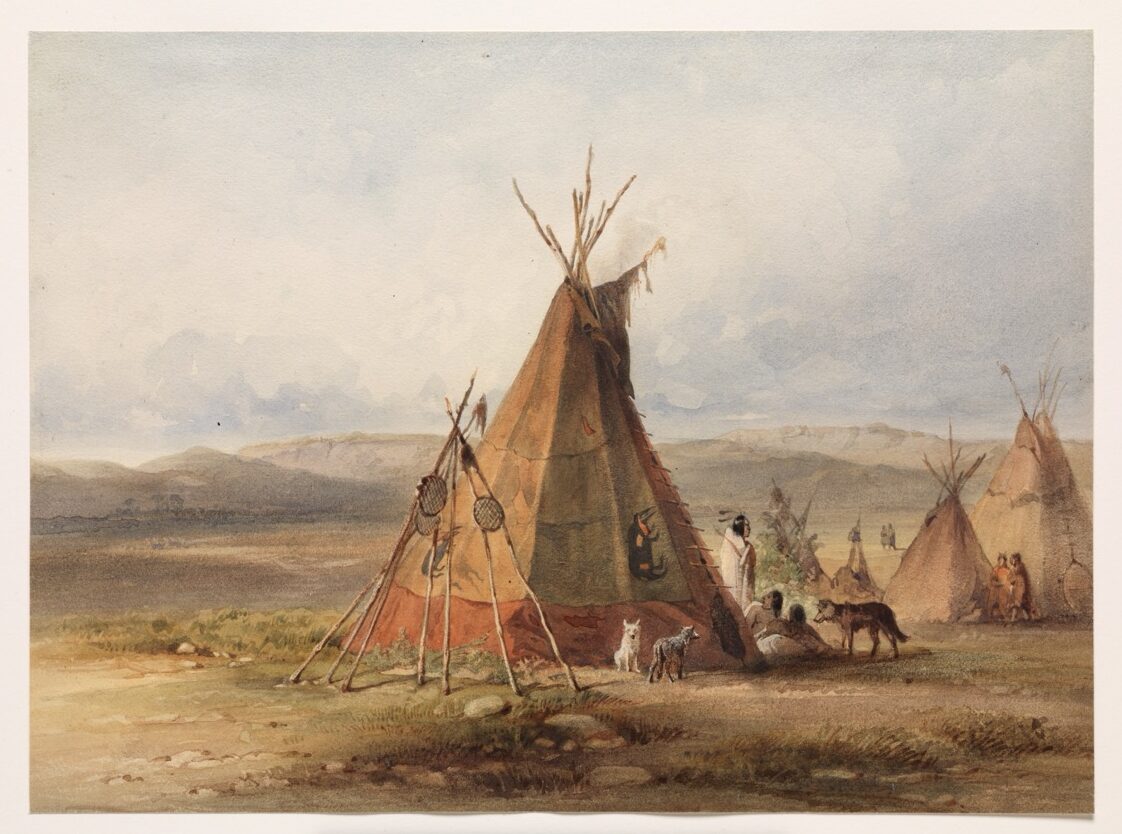
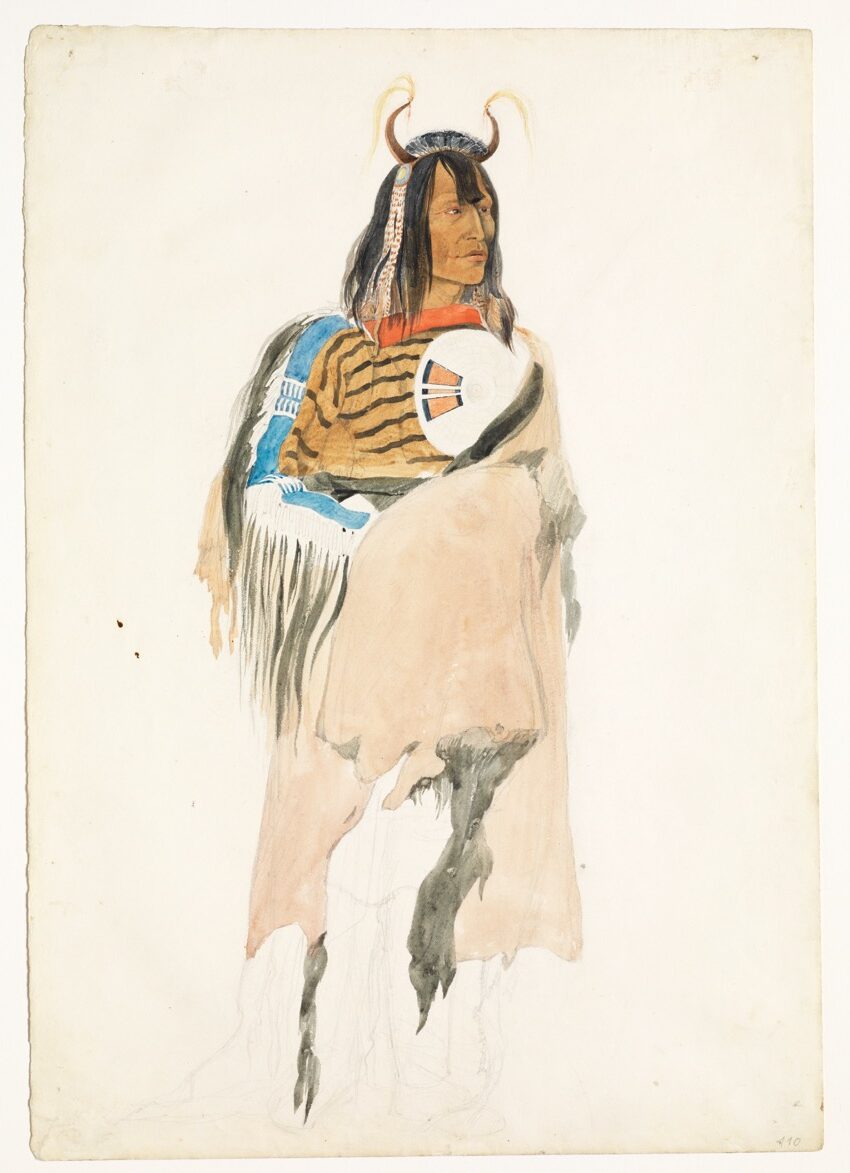
Meanwhile, on the level prairie to the west of the fort, an indescribably interesting scene was taking place. Hunting or traveling huts—only some of them covered with hides, most with green twigs, supported with poles—were immediately set up.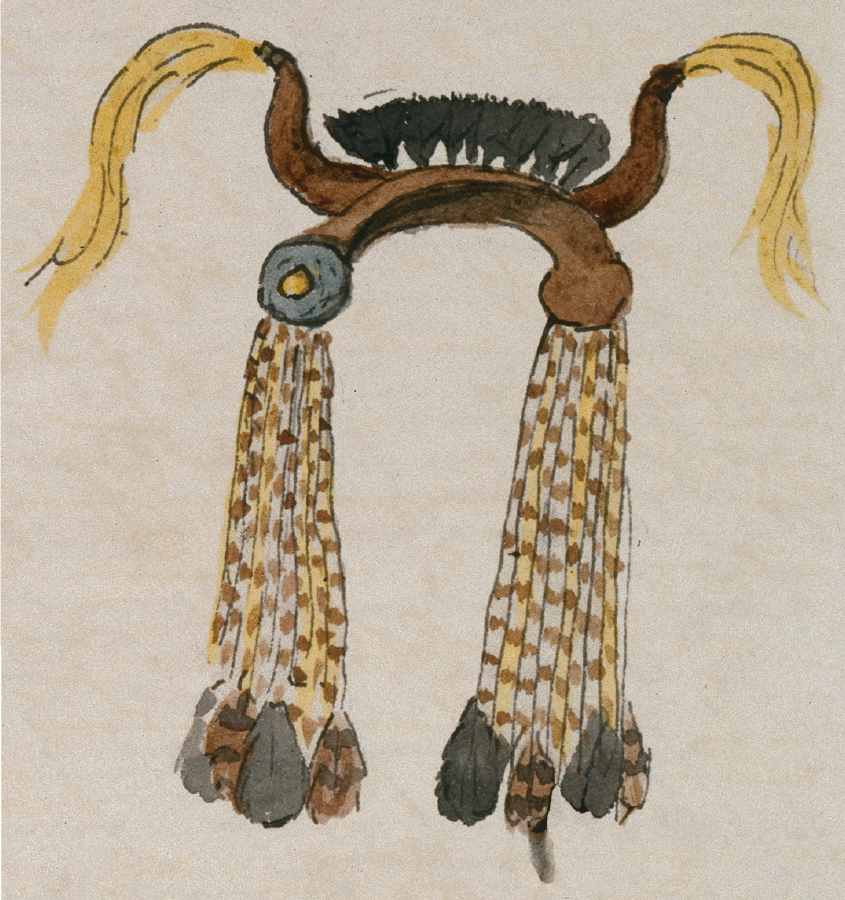 Here horses were grazing, there countless dogs were lying or moving about, and everywhere the Indians had dispersed in diverse groups. Some were sitting; others were occupied in various ways. The sight was indescribably colorful and interesting. The interpreter called a most interesting Indian to me; his name was Noapeh. On his head he wore a head ornament with antelope horns, and between them a crest of black, clipped feathers. He was to be sketched.
In the evening we again went to the camp and saw their huts. The baggage was arranged in a circle. Poles formed pointed huts, which were always scantily covered with twigs. In the middle a small fire was burning. Their way of packing is very practical. The dogs [each] have a skin pad on their backs on which rest two long poles that are connected above at an acute angle; at the lower end they are separated from each other. On the middle of these poles, there is an elliptical hoop with netting stretched over it on which are tied the packs, wrapped in hides.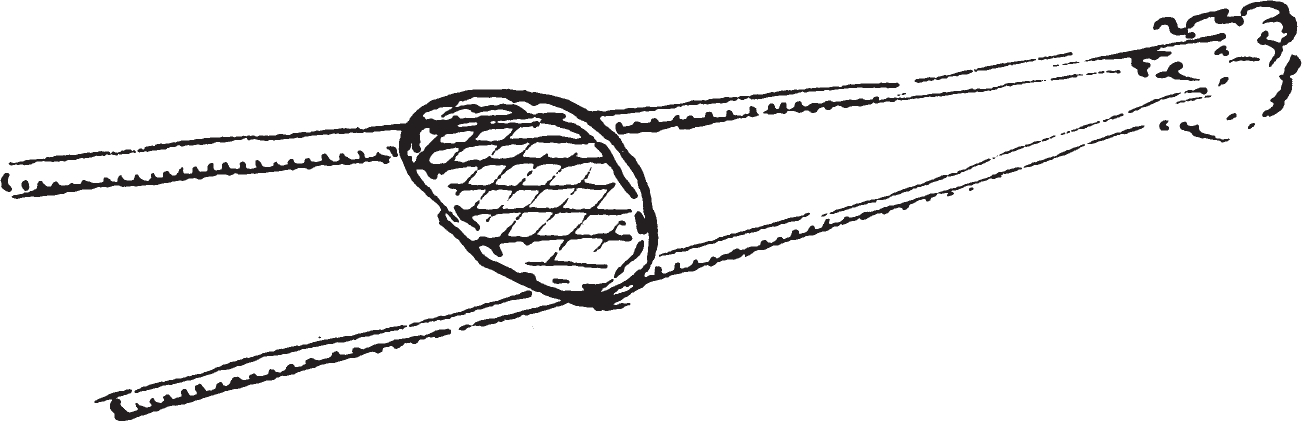
[Numerous] women and children had come along and were sitting around the small fires. As soon as one visited them, they asked for whiskey and tobacco. If one wished to exchange something with them, they demanded whiskey. Many had [already] bought some, and some of them had drunk too much. As soon as night fell, one heard them singing and shouting loudly; they were on the move everywhere and went back and forth to the fort. The commotion lasted all night, yet nowhere did scenes of an unpleasant kind take place. Late in the evening, lightning in several directions; the weather cooled off and changed.